Friday, February 29, 2008

Early Voting in Texas

Paul Gronke, our friend and colleague at Reed College who is a frequent contributor to the Election Updates blog, has been keeping track of early voting turnout in Texas. Here is a figure he posted yesterday showing how many more Democrats are voting early in the 2008 primary compared to 2004:


Gronke and other political scientists (including Adam Berinsky and Michael Traugott) have consistently found that convenience voting reforms like early voting do little on their own to increase turnout. But as we can see in Texas (and as Gronke points out in his post) the competitiveness of the Democratic primary in Texas - which leads to TV ads, candidate visits, surrogate speeches, telephone calls and mail - is probably what is driving turnout in this election.

Tuesday, February 26, 2008

Updated March 4th Democratic Delegate Estimates/Predictions: Clinton 188, Obama 182

As I've done since Super Tuesday, I'll be using survey data to estimate how the delegates will be allocated on March 4th. For the most part, these estimates have been fairly accurate (see here and here). I'm using the Pollster.com average of the recent surveys conducted in each state.


These estimates show that Clinton and Obama are currently set up to split the March 4th delegates roughly evenly.

However, there are three reasons to be cautious about these estimates. First, we are still a week away from the primary date, and a lot could change in that span of time. Second, at least in recent primaries, the polling has tended to underestimate Obama's support. This was not only the case in Wisconsin, but also in the Potomac primaries. It is unclear whether that will be the case on March 4th as well. Third, and perhaps most importantly, the Texas system is quite complicated and it is not easy to estimate how things will turn out there. They use a primary-caucus hybrid, which is explained in their delegate selection plan (summarized on p. 32 of the document). Essentially, 126 of Texas's pledged delegates will be allocated according to the results of the primary. However, on the night of the primary, Texas will also hold precinct caucuses. Those caucuses will eventually determine the division of the remaining 67 pledged delegates. Obama's strength in caucuses is well-known by now...he has been winning caucus events by 2-to-1 margins. If this advantage holds up in Texas, then Obama could come out of the state with a lot more delegates than the polling suggests.

I will update these predictions over the the next week as we get more polling in these states.

UPDATED on 2/27.

Conference on the Party Conventions

Conference on Conventions
April 2, 2008
Mary Graydon 5 and 6
Dr. James Thurber of the Center for Congressional and Presidential Studies and Mike Berman of the Duberstein Group will host a conference on the 2008 National Party Conventions.For further reading about topics that will be discussed at the conference, please visit out Party Conventions research page.
For more information on the event, please visit the event listing at the CCPS website.
To RSVP, please email Andrew Maletz at maletz@american.edu.

Monday, February 25, 2008

Obama Leads Narrowly in Newest Texas Polls; Clinton Leads Among Early Voters

Four Texas polls were released today. All of them are close, but three of the four put Obama ahead. The CNN poll has Obama up 50-46%; Survey USA has Obama up 49-45%; American Research Group has Obama up 50-42%; and Rasmussen has Clinton up 46-45%.

The Survey USA poll shows that 25% have already voted. Among these early voters, Clinton apparently holds a 51-46% advantage. Thus, she may be banking a small advantage just like she did in California in the weeks before Super Tuesday.

According to the crosstabs for this poll, white voters break 56-39% for Clinton, which is actually up from the last poll Survey USA conducted in the state a week ago (she led 53-41% among whites then). But Obama has increased his support among African Americans (from 77% to 85%) and cut into Clinton's support among Hispanics. A week ago, Clinton held a 65-32% advantage over Obama among Hispanics, but that is now 52-39%, with 8% now undecided. That is the biggest shift in support in comparing these polls.

Clinton's advantage among women has decreased from 62-35% to 53-42% now. Her lead among Democrats has also shrunk from 55-41% to 49-47% now. On the other hand, Obama's advantage among independents has declined from 60-32% to 55-39%.

Do National Media Frenzies Reach the Local News?

For my inaugural post on the CCPS blog, I thought I would err on the side of simplicity. Indeed, those who know me might say that this isn’t a long trip…

A regular component of classes I teach on both the presidency and politics & the media pay some attention to presidential strategies of “going public.” One distinct advantage presidents have when doing a round of news interviews with local reporters is what I call the “Gee, it’s great to be interviewing you, Mr. President” effect, where local reporters often get gobbled up by both the intimidation factor of interviewing the president and facing the onslaught of the presidential message machine. Often, this results in local journalists reporting very positively on the news of the president’s local efforts, ignoring issues that are of interest to White House reporters and political opponents of the president. The same thing often happens in presidential campaigns, where national correspondents bored of the same old stump speech cover different elements of an event than the local reporters who are all jockeying for their 2-minute “exclusive” with the candidate.

Today, the national news media is all aflutter about a picture the Drudge Report first posted of “dressed” Barack Obama. The picture is of interest to the mainstream media (MSM) because of continued false allegations and reports that Sen. Obama is a Muslim, when in fact he is a member of the United Church of Christ. Do Texas and Ohio newspapers care about this? After all, it’s on the front page of foxnews.com and the CNN “Ticker”…

Not so much.

The Cincinnati Enquirer is reporting a relatively lazy story about how crowds are gathering to hear Obama speak while the Columbus Post-Dispatch has a horse race story about Obama closing the gap with Sen. Hillary Clinton in the Buckeye State. The Post-Dispatch also has a substantive story about NAFTA, an issue Sen. Obama has been pushing in direct-mailings and Sen. Clinton has been responding to by saying “Shame on you Barack Obama” at a campaign stop/new viral video. The Cleveland Plain Dealer has a few stories on the upcoming debate at CSU and a story about Sen. Clinton’s criticisms of a 527 ad from labor folks who favor Obama. For those who keep track, two major Ohio papers have endorsed Obama, one has endorsed Clinton. All three have endorsed, (big surprise) John McCain.

Over in Houston, media coverage seems to be following the “Gee, it’s great to be interviewing you, Mr. President” line a bit more closely. The Houston Chronicle follows Chelsea Clinton to campaign events at churches, reports on Sen. Clinton’s assurances to donors that her campaign is on track, previews a Michelle Obama rally, and mentions the opening of another Obama campaign office. Perhaps not surprisingly, there is a link to a story that Obama is closing the gap in Ohio…

Down the road in San Antonio, there is a mix of news (NAFTA) and insult (an op-ed mocking Sen. Clinton). The San Antonio Express-News also covers Louis Farrakhan’s unsolicited endorsement of Obama. We should expect news of this endorsement to be wrapped into MSM coverage of a “dressed Obama.”

All in all, it appears as though the local newspapers covering the election are focusing on three things: 1) what the candidates tell them to (here a rally, there a rally), 2) the horserace (Obama is closing the gap, 527 ads), and 3) NAFTA (a substantive policy disagreement wrapped in a horserace story about tactics). There’s not a mention of a “dressed Obama,” the Clinton campaign’s involvement in promoting the photograph, the Obama campaign response, or the Clinton campaign response to the Obama response.

Of course, it's only noon...

Saturday, February 23, 2008

Accuracy of Unpledged Superdelegate Predictions (Through March 3rd)

For the last several weeks, I have been using statistical models to generate estimates for how likely each unpledged superdelegate was to vote for Hillary Clinton or Barack Obama. You can find last week's estimates here. Last week I posted on how well the model had performed in predicting the decisions of the superdelegates who had decided since we generated the predictions. At that stage, the model had gotten 65.5% correct.

I generated the most recent predictions on February 16th. Since then, 36 superdelegates (for whom I generated predictions) announced their support for either Obama or Clinton. Using these endorsements, we can once again test the accuracy of the model. As always, I am using the Democratic Convention Watch site for data on which superdelegates have endorsed which candidate.

The model correctly predicted the support for 75% of these 36 superdelegates, slightly better than the first model performed. Overall, the models have correctly predicted 71% of the delegates since I began generating the estimates. Among the endorsements that the model correctly predicted were those of Senators Chris Dodd, Byron Dorgan, Jay Rockefeller, and Russ Feingold (all for Obama).

UPDATED on 2/4

NOTE: I will be using the updated endorsement information to generate new predictions after the March 4th primaries.

First March 4th Democratic Delegate Estimates: Clinton 196, Obama 174

We are still over a week away from the March 4th primaries that most agree are crucial to determining whether Clinton will remain in this campaign. It is not entirely clear what the bottom line is for the Clinton campaign. If she wins Ohio but not Texas will she remain in the race? What if she wins both, but only narrowly? What if she loses both but only narrowly? And how important is the delegate count to these considerations?

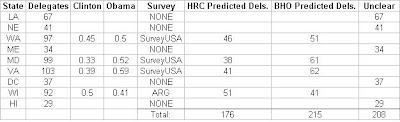
As I've done since Super Tuesday, I'll be using survey data to estimate how the delegates will be allocated on March 4th. For the most part, these estimates have been fairly accurate (see here and here). For Ohio and Texas, I'm using the Pollster.com average of the recent surveys conducted in each state. In Rhode Island and Vermont, the only recent polling I've found was conducted by American Research Group last week. While American Research Group surveys have often produced odd results (most recently in the days leading up to the Wisconsin primary), it is all we really have in those states right now. The estimates for the March 4th states are presented in the figure below:

These estimates show that Clinton would pick up a net gain of about 20-25 delegates on March 4th. By most counts, Obama presently holds about a 150 delegate lead among pledged delegates, which means he would still hold more than a 100 delegate advantage over Clinton after the March 4th primaries.

However, there are three reasons to be cautious about these estimates. First, we are still over a week away from the primary date, and a lot could change in that span of time. Second, at least in recent primaries, the polling has tended to underestimate Obama's support. This was not only the case in Wisconsin, but also in the Potomac primaries. It is unclear whether that will be the case on March 4th as well.

Third, and perhaps most importantly, the Texas system is quite complicated and it is not easy to estimate how things will turn out there. They use a primary-caucus hybrid, which is explained in their delegate selection plan (summarized on p. 32 of the document). Essentially, 126 of Texas's pledged delegates will be allocated according to the results of the primary. However, on the night of the primary, Texas will also hold precinct caucuses. Those caucuses will eventually determine the division of the remaining 67 pledged delegates. Obama's strength in caucuses is well-known by now...he has been winning caucus events by 2-to-1 margins. If this advantage holds up in Texas, then Obama could come out of the state with a lot more delegates than the polling suggests.

I will update these predictions over the the next week and a half as we get more polling in these states.

Friday, February 22, 2008

New Contributor to CCPSBlog

We are welcoming a new contributor to CCPSBlog. Mike Wagner is an assistant professor of political science at the University of Nebraska. Mike does research on public opinion, news coverage of politics, and campaigns, so he should bring some excellent additional insight with his posts.

Why Has Obama Caught Up in Texas But Not in Ohio?

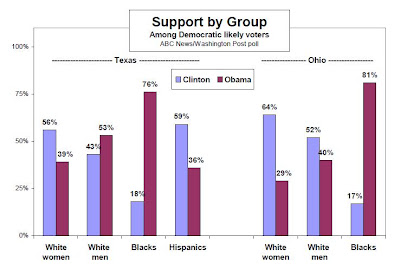
The ABC News/Washington Post polls released yesterday showed that Obama has closed the gap in both Texas and Ohio, but he has closed a lot more in Texas. In Texas, Clinton holds a lead within the margin of error, 48-47%. In Ohio, Clinton's lead is a bit bigger, 50-43%. Why has Obama come within a statistical tie of Clinton in Texas but not Ohio? Well, the answer appears to be white men and, to a lesser extent, white women. Obama holds big leads among African Americans in Texas and Ohio, as he has in nearly every state. Clinton's lead among Hispanics in Texas is approximately what it has been in many other states as well. But while Obama leads among white men in Texas (53-43%) he trails among that group in Ohio (40-52%). While he trails among white women in both states, he trails by a larger gap among that group in Ohio. I've included a figure from ABC's release here:


This illustrates the challenges facing both candidates in the next week and a half. Clinton needs to hold on to white men in both states, something she has not been able to do in recent primaries. She also needs to keep big margins among white women--those margins have been smaller in recent primaries. Obama needs to cut into Clinton's support among those two groups, particularly in Ohio. It will be interesting to watch whether we see any movement in support among these groups in the next week or so.

However, the other key for Obama is getting big turnout among African Americans in both states. Since that group votes so overwhelmingly for him (usually about 85%), he gets huge bang for the buck if he drives up turnout among African Americans. Clinton would similarly benefit from higher than normal turnout among Hispanics in Texas.

Thursday, February 21, 2008

Obama's January Fundraising

It is true that inflation is driving down the value of the American dollar, but even if you take that into consideration, the amount of money Barack Obama raised in January of this year is incredible. Heck, the $19 million raised by Clinton would've been astonishing in any other election year, but Obama nearly doubled that, raising about $36 million in January alone. Just a few years ago, $36 million would've been a good haul for the entire primary campaign, much less one month!


The Campaign Finance Institute released information on the amount of money raised by the Democratic and Republican candidates in January of this year. Here is the Table outlining what candidates in each party raised. Also of note is that nearly half of Obama's haul came in the form of $200 contributions or less and over two-thirds were contributions of less than $1,000. These are donors that he can go back to if he needs to, either to run an extended primary campaign or to raise money to compete with McCain over the summer. And if you are wondering why Obama is now hedging about whether he'll accept the general election grant money, consider that since last January, he has raised almost twice as much for the primary as the size of that grant in 2004.

Michigan to Obama: We Forgive You? Florida to Obama: We Don't?

There have been a slew of polls in the last week or so showing essentially the same thing: nationally, Obama fares better than Clinton against McCain and the same is true in most states. Some of the most notable states where this is the case are red states. In Virginia, SurveyUSA shows Clinton trailing McCain by 3% while Obama leads McCain by 6%. In Kansas, they show Clinton trailing McCain by 24%, but Obama behind by just 6%. In Iowa, they show Clinton down by 11% to McCain, while Obama is up by 10%. Even in Clinton's home state of New York, they show Obama beating McCain by a larger percentage than Clinton.

These survey results all play into Obama's claim that he is the strongest opponent to face McCain in the fall. But the state numbers I found most interesting were those from Michigan and Florida (these courtesy of Rasmussen). Some Democrats have feared that if Obama was the nominee, he might suffer in Michigan and Florida during the general election because of the controversy surrounding whether the delegates will be counted at the general election. In Michigan, Obama went so far as to have his name removed from the ballot. Yet, if there is significant residual unhappiness with Obama over this move, it is not showing up in these survey results. While Clinton and McCain are tied in Michigan at 44%, Obama holds a 47%-39% lead over McCain.

Florida's memory may not be as short as Michigan's, however. In Florida, while McCain leads Clinton 49-43% in Florida, he is ahead of Obama in the state by 16% (54-37%).

If Obama is the nominee, will he be able to close the gap with McCain in Florida? How much would it help his general election campaign if he finds a way to make sure the Florida delegation is seated?

Tuesday, February 19, 2008

Wisconsin Democratic Primary Recap

The bar going into tonight seemed to be double-digits...if Obama won by double-digits, he could claim a clear victory. If Clinton had kept his margin to single-digits, her campaign could have claimed a moral victory. Right now, with 85% of the precincts in, Obama is up 58-41%, showing that he exceeded expectations yet again. This may be the most striking thing about the (soon to be) 10 state winning streak...in most of these contests he hasn't just won, he has won big, and exceeded expectations at every turn.

One interesting note is that the composition of the Democratic electorate was almost exactly as it was in 2004. According to exit polls, 9% of those voting in the Democratic primary were Republicans, 28% were independents, and 62% were Democrats. The high turnout among independents and Republicans helped Obama widen his margin of victory, but he even won Democrats 53-46%.

Obama's margin was also wider than what the polls predicted, something that we also saw in last week's primaries. As a result, rather than taking a net gain of 6 delegates from Wisconsin (which is the estimate I generated based on the polls) he will likely take a net 12 delegate advantage from the state.

As has already been widely reported, Obama won white men 63-34% and white women went only very narrowly for Clinton (52-47%). Obama also won union households by about 10%, perhaps helped by his recent union endorsements. He won nearly every demographic except, as the commentators kept pointing out mercilessly, Clinton carried old white women.

What High Independent Turnout Means for Clinton, Obama, and McCain in Wisconsin

In earlier states, we've seen that Obama tends to fare well among independent voters. Wisconsin has an open primary, which means that Obama can again benefit from independents voting in the Democratic primary. However, trying to figure out exactly what independent turnout will be, and which primaries those independents will vote in is a bit trickier.

In 2004, exit polls indicated that independents made up 29% of those voting in the Democratic primary. Republicans made up 9% of the Democratic electorate that year as well. Of course, the Republican primary that year was meaningless since Bush was running unopposed. This year, some independents may choose to vote in the Republican primary, even if that party's nomination race is all but over. Thus, even if you factor in larger than normal turnout for the primary, it seems unlikely that more than 1/3 of the Democratic primary electorate will be comprised of independents or that more than 10% would be Republicans.

Public Policy Polling, a Democratic survey firm, is showing that Obama holds a marginal lead among Democrats, but a much stronger advantage among independents and Republicans. Overall, their poll shows a 53-40% lead for Obama. Their sample was comprised of 71% Democrats, 9% Republicans, and 20% independents. But what happens if you shift the numbers to make this year's electorate look like the one that turned out in 2004? If that happens, you have a larger share of independents (29% instead of 20%) and a smaller share of Democrats (62% instead of 71%). If you shift the numbers like that, you get Obama receiving 54%, Clinton with 38%, and 8% undecided. The gap between Obama and Clinton grows from 13% to 16%...not a huge difference, but it could be big enough to affect perceptions as well as an extra delegate or two.

But what does it mean for McCain if all the independents vote in the Democratic contest? Based on how the vote has divided in the earlier contests, we might expect it to hurt McCain, but the same survey suggest otherwise. In that poll, McCain actually held a 14% lead over Huckabee among Republicans but just a 4% lead with independents. However, American Research Group finds the opposite (and more expected pattern) in their survey. But McCain lead Huckabee among both groups, so he should win Wisconsin regardless.

Wisconsin Democratic Primary Delegate Prediction: Obama 40, Clinton 34

There have been several polls since the Wisconsin prediction I made on Friday. However, nothing has really changed based on those polls, so the delegate estimates for Wisconsin remains the same. If the polling is correct, Obama would receive 40 delegates to Clinton's 34. As always, these estimates are based on the polling averages generated by Pollster.com.

There has been one notable quirk in the surveying over the weekend. The polling produced by American Research Group has been quite volatile. On Saturday, ARG was the only polling firm to show Clinton with a lead in Wisconsin, 49%-43%. However, two days later, ARG's polling now resembles most of the other surveys that have been conducted in the state, giving Obama a 52%-40% lead. Surely there wasn't a shift in support that was this significant over two days, so what is really going on here?

In the last several states, the polling has understated Obama's support, so it will be interesting to see if that happens in Wisconsin as well. Wisconsin has an open primary, so will independents vote overwhelmingly in the Democratic contest, providing more support for Obama? Or has Clinton gained any traction by focusing on the state in the last several days?

It seems like most of the pundits expect Obama to win, but not by as much as he has in the last several states. Thus, an Obama loss would be a blow to his momentum in the race. The Clinton campaign has seriously contested Wisconsin, so they can't really afford to lose the state 60%-40%. The polling in Texas is already starting to tighten, and another Obama blow out would not help the Clinton campaign at all.

Saturday, February 16, 2008

Updated Predictions on Unpledged Democratic Superdelegates

Discussion of Democratic superdelegates continues as the Democratic race remains close. While Clinton presently leads Obama among super delegates who have pledged their support, about half of the superdelegates remain uncommitted. So who will these unpledged superdelegates support?

I have now updated the predictions for which candidate unpledged Democratic superdelegates are likely to support. As before, I use information about the superdelegates who have committed to a candidate to generate predictions for 321 unpledged superdelegates. I exclude superdelegates from DC and the territories because we lack complete data from those areas, and from IL, NY, and AR because superdelegates in those states have nearly unanimously cast their support for their native son/daughter. As always, information on the superdelegates is provided by the Democratic Convention Watch site. You can find more about they methodology I use here.

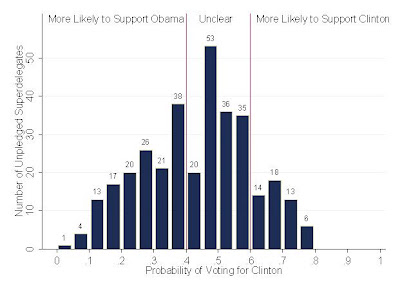
Check out the distribution of predicted support among unpledged superdelegates below. Superdelegates who are between 40% and 60% likely to vote for Clinton/Obama are labeled as "unclear." There are a lot of superdelegates in this range, 144 to be exact. There are 138 unpledged superdelegates who are at least 60% likely to vote for Obama; 51 unpledged superdelegates are at least 60% likely to vote for Clinton.

What these numbers suggest is that Obama may be able to significantly cut into Clinton's superdelegate lead with those superdelegates who have yet to decide. According to the Democratic Convention Watch site, Clinton currently holds a 76 delegate lead among pledged superdelegates. However, these estimates show that more of the unpledged superdelegates are likely to cast their votes for Obama than Clinton.

If these estimates are even remotely accurate (so far, the model has performed reasonably well), then it is unlikely that Clinton would be able to take a net advantage of more than a 100 superdelegates once all is said and done. This means that if Obama is able to build more than a 100 delegate lead among pledged delegates, it is unlikely that Clinton could make up that advantage with superdelegates.

You can see the estimates for each unpledged superdelegate here. As with the last estimates, the most likely supporters for Clinton come from MI, CA, and OH. Obama's most likely supporters come from VT, SD, WY, ME, NH, and MS. As always, these are estimates based on various factors (makeup of the state the superdelegate comes from, gender of the superdelegate, etc) and are useful for understanding tendencies, but less useful for making predictions about particular individuals.

Friday, February 15, 2008

Accuracy of Democratic Superdelegate Predictions

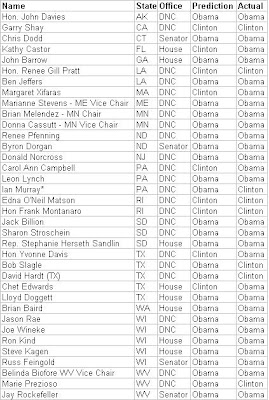
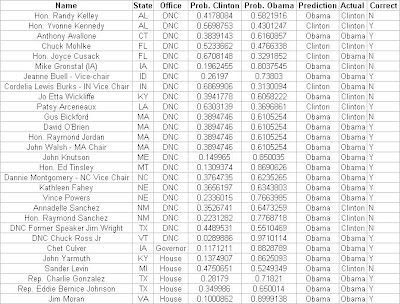
A week ago, I used statistical models to generate predictions for how likely each unpledged superdelegate was to vote for Hillary Clinton or Barack Obama. You can find the estimates here. Since I produced those estimates, 29 superdelegates (for whom we generated predictions) have pledged their support for one candidate or the other. Thus, we have our first chance to see how well our model does at predicting how unpledged superdelegates might vote. You can find that information in this table:


If you do the math, you'll see that the model correctly predicted 65.5% of the delegate decisions correctly. Thus, the model got nearly two out of every three superdelegates correct.

When the model did miss, it tended to miss on the the side of Obama. Only twice did I predict a superdelegate would support Clinton when he or she actually support Obama. The other 8 mistakes were in predicting support for Obama that actually went to Clinton.

I will use these new endorsements, along with information about superdelegates who have changed their votes and information about additional superdelegates that I initially had to leave out of the model to generate new predictions over the weekend. Hopefully with this additional model, I will be able to provide an even more accurate picture of who the unpledged delegates are likely to support.

Analyzing Texas Polling on March 4th Democratic Primary

Four surveys were released today and they show anything from an Obama lead of 6% (American Research Group) to a Clinton lead of 16% (Insider Advantage). But there is a lot of information available from the Texas Credit Union League surey that was conducted by Hamilton Research and Public Opinion Strategies. That survey puts Clinton up 49%-41%, but the useful part of this survey is that it includes over 100 pages of great crosstabs to look through. Here are a few things that stood out to me:

Obama has a 65%-16% lead among African Americans, who made up 18% of the sample. Hispanics made up 30% and Clinton holds a 63-32% lead among that group.

Obama is ahead among white men 50-44%, but trails badly among white women (27%-59%) and Hispanic women (21%-71%).

Independents made up 10% of the sample, and Obama led among that group 61-27%. Clinton led among Democrats 53-37%.

Interestingly, Obama is ahead among the 40% of respondents who said that they would vote early 46-42%. This runs counter to what seemingly happened in other states like California, where Clinton appeared to bank a lot of early votes.

One other interesting note...Clinton leads 54-32% among those who say the economy is the most important issue and she even leads 51-44% among those who say Iraq is the most important issue. But, oddly, those who said healthcare was most important were more likely to favor Obama, 53-43%. The numbers for Iraq and healthcare seem to run counter to what we have typically seen in other surveys.

Based on these figures, it looks like Clinton needs to hold on to white women and Hispanics to win in Texas. Obama needs to get high turnout from African Americans, and win 85-90% of that group as he has in other states, and he also needs to hold on to his advantage among white men.

In case you are wondering, in 2004, 24% of the Democratic primary electorate was comprised of white men and 27% was made up of white women. Hispanics accounted for 24% of the electorate while African Americans made up 21%. If we see roughly equal turnout among Hispanics and African Americans, then Clinton needs to keep a large margin among white women to make up for the fact that Obama will likely win African Americans by a larger share than she wins Hispanics.

Finally, independents made up 20% of the Democratic primary electorate in 2004, but only 10% of the sample for the Texas Credit Union League survey. If turnout among independents is higher, that would help Obama based on the support he is getting from that group in the survey.

CORRECTION: Thanks to xstryker for noting that I originally had the polling numbers in the first paragraph attributed to the wrong polling organizations.

Thursday, February 14, 2008

Accuracy of Potomac Primary Delegate Estimates and a Wisconsin Delegate Prediction

We have final delegate estimates in from Virginia and DC, but we are still waiting for final counts from Maryland. Nevertheless, it is certainly not too early to say that the polls underestimated how many delegates Obama would pick up in the Potomac Primary. On Monday, I used pre-election polling to estimate that Obama would have a net gain of about 40 delegates from the Potomac Primary. However, the polls appeared to underestimate Obama's support in each state, which led to an underestimation of the number of delegates he would win.

In Virginia, I predicted that Obama would win 50 delegates to Clinton's 33. In fact, Obama won 54 delegates and Clinton won just 29. Thus, the estimate was off by 4 delegates in that state. In DC, the estimate was that Obama would win 10.5 delegates to Clinton's 4.5. I rounded both up, but that meant I was giving out one more delegate than DC had (oops!). Nevertheless, even by doing that, I was still off by just one delegate for Obama's total, and 2 from Clinton's total.

What I was really interested in seeing, however, was how much better Constituent Dynamics did compared to me. As some of you know, Constituent Dynamics used automated polling techniques to provide some great polling information across 60 congressional races in 2006. Leading up to Tuesday, the organization conducted 14,276 interviews in MD, VA, and DC for the Potomac Primaries. This gave them enough interviews to make predictions by congressional district, which is the level at which a significant share of the delegates are allocated. My method, on the other hand, simply allocates delegates by the statewide polling numbers and assumes district variations will even out when aggregated.

How much better did they do compared to my estimates? Well, they didn't do better at all. In fact, they did slightly worse. In Virginia, they predicted 45 delegates for Obama, 32 for Clinton, and called 6 too close to call. If you divide the too close to call delegates evenly between Obama and Clinton, then my estimates based just on the statewide vote were closer to the final totals than theirs. The only way their estimates come closer than mine is if you assume that all 6 too close to call delegates when to Obama. In DC, their estimates were essentially the same as mine. (Once Maryland's delegates are tallied, I will update this post to tell you how we both did in that state, but I think I'm going to be closer there as well.)

Thus, the Potomac primaries provided for an interesting (though limited) test of whether polling by congressional district allows for a more accurate prediction of delegate allocations compared to having just statewide data. Based on this limited test, statewide polls fared at least as well in predicting delegate allocations as polling conducted by congressional district (and just polling the state is less expensive). This does seem to provide support for the assumption that I make when I use these surveys to predict the Democratic delegate estimates--that is, that variation across congressional districts will even out when delegate shares are aggregated to state totals.

Finally, I've seen no polling from Hawaii, but in Wisconsin there have been several surveys, so I'll use the Pollster.com average to make the delegate prediction. Based on the current average available on Pollster.com, Obama should win 40 delegates on Tuesday compared to 34 for Clinton. While that is the estimate, it will be interesting to see if Clinton can pull a New Hampshire type of upset or if Obama wins by bigger than expected margins once again. Thoughts on this?

(I'll have a new Superdelegate Prediction up in the next few days, with updated data and information on how we've done with our predictions so far.)

UPDATE: Pollster.com added another Wisconsin survey to their average last night which shifted the numbers slightly. I'm now esimating 40 delegates for Obama and 34 for Clinton.

Does this break the losing streak?

Clinton has officially won the New Mexico primary. Of course, the New York Times was already telling us that she would get 14 of the 26 delegates and this announcement does not change this. But can she claim that she has broken Obama's 8 state winning streak even if the state she won voted back on Super Tuesday?

Wednesday, February 13, 2008

One More Thing...

As if Clinton wasn't having a bad enough week with 8 consecutive losses and staff shakeups, she has fallen behind Obama in Gallup's daily tracking poll for the first time since they began the series in early January. Of course, it is worth mentioning that the Obama lead is within the margin of error.

Unpledged Superdelegate Predictions Methodology

I've had some readers ask for more information on the methods I used to generate the predictions of which candidate the remaining unpledged Democratic superdelegates are more likely to support. This post may be a bit technical for some, but I'll do my best to explain the methodology and the logic behind it.


The idea here is that we have a lot of information about who has endorsed and which candidate they have endorsed. I argue that based on that information, we should be able to get an idea of how the unpledged superdelegates might cast their votes. This is particularly true if superdelegates largely choose their endorsements based, at least partly, on what their constituents would want.


To model this, I first throw out superdelegates from IL, AR, and NY, because they all seem to be backing their favorite son/daughter. Then I begin by using a logit model to predict whether a pledged delegate chose to support Clinton or Obama. The factors I include in this model are the superdelegate's gender and whether the superdelegate is a DNC member (the idea being that DNC members may behave differently from elected officials). I also include the 2004 vote for Bush (%) in that superdelegate's constituency (whether it be the state or the congressional district), the percentage of the superdelegate's state that is unionized, the percentage of the state that is college educated, and the percentage of the state's population living in urban areas. We also included the state's per capita income. These are all factors that the exit polls have shown to have an effect on whether one votes for Obama or Clinton, so incorporating them into the model allows us to capture whether the superdelegate comes from a state more predisposed to one candidate over the other.

Based on these factors, the model is able to correctly predict 73% of the superdelegates who have already pledged their support to one candidate or the other. The strongest factors influencing whether a superdelegate backed Clinton was whether the superdelegate was female, and if the state the superdelegate came from was highly unionized and more urban. Obama fared better among male superdelegates and those from states with larger college educated populatoins. Interestingly, the race and ethnicity of the superdelegate did not appear to have a significant influence on who a superdelegate supported.

Now, I could just use the logit model to predict the unpledged superdelegates, but if I do that I'm not accounting for the fact that there is likely something about superdelegates who have already pledged that makes them different from those who have chosen not to. To account for this, and this is where it gets real technical, I employ a Heckman Selection Probit model. Essentially, this model first estimates whether a superdelegate chose to support a candidate at all to this point and, if they did, then estimates which candidate they chose to support (using the information described above). I find that the two factors influencing whether a candidate ahs endorsed at all at this point are whether the superdelegate's state has had its primary/caucus yet and whether the superdelegate was a DNC member (rather than an elected official). Superdelegates were less likely to have endorsed anyone if their state had not yet voted and if they were a DNC member (i.e. not an elected official).

Using the Heckman probit selection model, I then generate the predicted probability that a superdelegate who has not yet endorsed will endorse Clinton or Obama when they cast their vote. As I noted in the earlier post, I find that more unpledged superdelegates would be favorably disposed to Obama rather than Clinton.

Of course, there are several reasons to be cautious about these estimates. First, the model only correctly predicts 73% of the superdelegates who have already pledged. This means the model will be wrong at least one out of every four times. Second, these models rely heavily on what has already happened, yet the dynamics of the race are changing significantly each day. What led someone to endorse a particular candidate two months ago may not be the same thing influencing where they stand now. Third, as I've noted elsewhere, I suspect that a significant number of superdelegates are going to vote for whichever candidate is ahead in pledged delegates rather than who they might support otherwise. Obviously this model is not necessary if that happens.

Nonetheless, this is an interesting exercise and it will be fun to see how the results turn out in teh coming weeks. I will try to update the model at least once a week for as long as there is a reason to do it. As always, thanks to Alicia Prevost and Caitlin Zook for their help collecting the data.

If you have more questions about the methodology, leave a comment and I'll be happy to answer them.

Tuesday, February 12, 2008

Potomac/Chesapeake Tuesday Live Blog

Midnight Hour (Final Thoughts)
Obama has once again exceeded expectations and McCain has done what he needed to do. Obama is going to pick up a net gain of about 50 delegates, which was larger than the 40 delegate margin I predicted using the preelection polls. The campaign now shifts to Wisconsin where the latest survey shows Obama up 50-39% and McCain up 53-32%. Add in Hawaii, where Obama spent part of his childhood, and it looks as though Obama may have won 10 in a row before March 4th.

How stunning is it that Clinton did not seem to get 40% in any of the primaries tonight?

The good news for Clinton is that a new Survey USA poll puts her up in Ohio 53-39%. The bad news is that Obama has several weeks to cut into that lead. The Dems will have debates between now and March 4th, so it will be interesting to see how those play out. How aggressive can Clinton be without risking a backlash like what happened in South Carolina.

In Maryland, not one, but two House incumbents are in trouble. Al Wynn is behind 59-37% with half the precincts reporting, and Wayne Gilchrest is 40-36%, also with a little more than half of the precincts in. Could two House incumbents fall in one night? It isn't that common that House incumbents lose primaries.

I think we'll see a lot more about Superdelegates, particularly as we have a couple of weeks with no contests. How likely is it that we'll get something like a "gang of 200?" I'll be up with an update on the Superdelegate model now that several states have voted and more superdelgates may have committed. I'll also give out more detail on how we are modeling what these superdelegates will do.

Finally, I'll start producing delegate estimates for the upcoming primaries and post on how the Potomac Primary predictions fared (though, I can tell you now I underestimated what Obama would win tonight). But for now, I'm off to bed.

11:20pm
Time for second-guessing: To what extent are Clinton's problems a function of poor strategy? As I've suggested a couple of times, it seems as though the ground operation was largely absent from the DC area in the past week. Clinton essentially decided to skip every race between Super Tuesday and March 4th because they didn't think they could win those states. But by failing to seriously campaign in these states, the storyline is not just about Obama victories, but about landslide Obama victories and the fact that Obama now has a delegate lead. Given the PR rules, shouldn't the Clinton campaign have fought hard to keep Obama's margins down over the past week? Ignoring states where you are going to lose just makes 55-45% defeats into 65-35% defeats, and there is a big difference between those in terms of both perceptions and tangible delegates.

10:58pm
Howard Fineman was just on MSNBC noting that the Hillary campaign believes the best it could do at this point is finish close behind in pledged delegates; they don't think they can finish ahead.

It will be interesting to see how this plays out in the next few weeks. Surely the Clinton campaign wishes that Texas and Ohio were voting tomorrow. However, Obama has 16 days after Wisconsin votes to campaign in Texas and Ohio. That is a lot of time to make inroads in those states.

10:52pm
Maryland voters were also participating in Congressional primaries today. Embattled incumbent House member Al Wynn (D) is vying to become the first incumbent to lose a reelection campaign in 2008. With 11% of precincts reporting, he is trailing challenger Donna Edwards 55-42%.

10:11pm
And along the lines of the last post, turnout in the Democratic primary in Virginia about doubled turnout in the Republican primary. (Of course, the Republican race is nearly over, while the Democratic race is neck-and-neck, but still striking).

10:07pm
Striking contrast as the networks cut away from Obama speaking to an arena-sized crowd (like the one Clinton spoke to earlier) to join McCain speaking to a ballroom-sized group.

9:59pm
From the MD exit polls:
Obama won 54% of white men; he won 46% of all whites and 88% of African Americans. Independents were 13% of the Democratic electorate, and he won 68% of that group. He won 70% of first time voters.

McCain still hasn't won a majority of conservatives...he captured 43% in Maryland, but 70% of moderates. And he won just 35% of born-again Christians.

9:38pm
Eight minutes after Obama completes the Potomac sweep, out he comes to address the crowd in Wisconsin. I imagine that he won't be ignoring the results of today's primaries in his speech.

9:35pm
Why is Clinton in Texas rather than Wisconsin? A poll taken immediately after Super Tuesday had her up 50-41 in that state. However, a poll released today reverses that and puts Obama up 50-39. How worried is the Clinton campaign that they might see similar shifts in Ohio and Texas once the Obama campaign lands in those states?

9:30pm
Maryland has been called for Obama and McCain by the networks.

9:25pm
Clinton makes no mention whatsoever of the fact that 3 states held primaries today...the networks all break away from her speech. Polls finally close in Maryland soon.

8:52pm
Clinton is expected to speak soon from Texas. Will she even acknowledge today's primaries? Will she make any note of Wisconsin? Or will it all be about Texas and Ohio?

The dominant storyline in the media tonight...Obama's inroads among white men.

8:33pm
CNN has called Virginia for McCain...the McCain campaign is surely breathing a huge sigh of relief right now. It definitely looks like the open primary drove down his numbers in Virginia, which will just give Huckabee all the more reason to stay in this campaign for another week.

8:31pm
Wolf Blitzer notes that CNN is not calling the race in DC yet since they have no exit poll data and no real vote returns yet. Sure enough, there is no exit poll data on DC, yet MSNBC called it at 8:00pm exactly. Does that seem odd to anyone else?

8:21pm
MSNBC earlier put up a map that seemed to have Washington DC sitting on the shores of the Chesapeake Bay in Maryland. Is it not bad enough that the district has no representation in Congress? Isn't placing the city in Annapolis just adding insult to injury?

8:14pm
Obama is holding a steady 62-37% lead in VA with about one-third of the precincts reporting. If that margin held, he gets about a net gain of about 20 delegates out of the state.

8:00:01pm
Barack Obama is projected to win DC. The McCain-Huckabee race is too close to call. Does anyone thing that this is because they couldn't find enough Republicans in DC to conduct a reasonable exit poll?

7:42pm
I had a friend report that she received a robo call from Michelle Obama at 7:30pm. It seemed odd at the time since the polls were going to close in 30 minutes. But now it has been announced that the polls are staying open until 9:30pm. Did the Obama campaign decide to crank up the robo calls once they heard this?

Evidently DC polls will still close at 8pm.

7:35pm
The Obama campaign will surely be talking about these numbers from Virginia. 67% of independents (22% of the electorate in the Democratic primary) went to Obama. Republicans made up 7% of the Democratic primary electorate, and he won them by over 70%.

7:10pm
According to Virginia exit polls, Obama won 90% of African Americans. He also won with white men and virtually split the white vote altogether. More to come...

7:08pm
According to leaked exit polls, Obama's margin is expected to be at least 60-40 in both MD and VA, and 3-to-1 in DC. Based on those estimates, I think they'll be calling MD and DC for Obama in about 52 minutes.

7:00:01pm
VA race has been called for Barack Obama and is expected to win a "substantial victory" tonight. The Republican race is too close to call so far.

The exit polls are suggesting as much as a two-to-one victory. As I look out the window, freezing rain is causing gridlock, which may be keeping some people from making it to the polls tonight.

6:44pm
Two VERY important nuggets from the Virginia exit polls (according to MSNBC). 68% of the Republican electorate identified themselves as conservative (it was 55% in 2004) and 46% we born again Christians. We know that McCain does not generally do that well among those groups. How much did the fact that Virginia has an open primary hurt McCain? Did a lot of moderate voters who would otherwise vote for McCain choose to cast their ballots in the Democratic primary instead?

6:29pm
This Washington Post graphic is a visually appealing way to get a sense of the campaigning that has happened in the Potomac region.

6:22pm
Don't forget the predictions we generated based poll averages over the past several days. Based on the polls, we expect Obama to come out of tonight with 103 delegates compared to 65 for Clinton 65. I'll keep close track of how we do, unless we don't do well. (Just kidding).

As for predictions, after writing a few days worth of "who are the superdelegates?" stories, most of the journalists and talking heads are now noting that it is highly unlikely that superdelegates would overturn a decision arrived at by pledged delegates. I agree entirely, but we'll keep updating our superdelegate predictions until we know something definitive.

6:13pm
More exit poll previews, this time from MSNBC. The Democratic electorate was 56% women, 29% black, 63% white, and 35% are first time voters (compared to 26% in 2004). Clinton has won with women in most contests to this point, Obama has won overwhelming support from blacks and first time voters.

5:24pm
Polls don't close for a couple of hours, but CNN is beginning to discuss their exit polls. Here is the one highlight of interest so far: in VA, 64% of Huckabee's voters are born-again Christians, compared to 32% for McCain voters. This suggests that McCain is still struggling to win over the social conservatives.

I can offer the following first-person account from my polling location in DC today. I counted 10 Obama signs, 2 Clinton signs, and zero signs for Huckabee or McCain. No big surprise with any of those, I'd say. There was a representative from the Obama campaign out front, but nobody else's campaign was represented. It was pretty quiet, but I went in the middle of the afternoon when there is rarely a crowd.

Monday, February 11, 2008

Live Blogging Potomac Tuesday

I will be posting tomorrow night as the results come in. Not sure it will be a very late night, since the way the polling looks, these races might all be called relatively early. But that will give me all the more time to analyze exit polls for you.

From walking around DC and Bethesda and talking people I know, it seems as though the Obama ground operation is awfully strong here relative to Clinton's. I've talked to people whose houses have been visited twice since Saturday by Obama supporters and the Obama signs outnumber Clinton signs by about 2-to-1. Of course, this is just an unsystematic accounting of what is really going on here, but it does seem to fit with what we've heard about the Obama operation in other states.

The Numbers Guy (Carl Bialik) examines the accuracy of our Super Tuesday predictions in his blog today.

The Michigan news media are abuzz with discussions of whether the state's party will schedule a caucus event in order to select delegates that would count. Here is one example. In the meantime, the state's Democratic Party allocated the delegates that they currently aren't allowed to send to Denver. Things seem a bit quieter in Florida.

UPDATE: This can't possibly be true, can it?

Potomac (or Chesapeake) Primary Delegate Predictions

UPDATED 2/11 (7:45pm)

After nothing for the first few days after Super Tuesday, we've now had several polls appear for the Maryland and Virginia primaries, and we've gotten our first poll of DC primary voters (compliments of Constituent Dynamics, which provides their own delegate estimates). Using the average of polls conducted in Virginia and Maryland over the past few days (5 in each state), I've produced an estimate of how the delegates should break down after Tuesday's voting. I am estimating how DC's delegates will be divided based on the single poll available for the district.
If these estimates are correct, Obama would pick up a nearly 40 delegate gain in the Potomac/Chesapeake Primary. This total would be similar to what he gained on Saturday night, and would give him a net gain of about 100 delegates in the last 4 days.

Speaking of Saturday night, I used a Survey USA poll to predict the delegate allocation in advance of Washington's caucuses despite my earlier failure in using polls to predict delegate allocations in Minnesota. Once again, the poll-based estimate was not a very good of the actual caucus outcome. The poll showed a 50%-45% lead for Obama (which would've meant about a 5 delegate pick-up), but he won 68% of the vote, which means he stands to take over a 30 delegate net advantage out of WA. The moral of the story is, once again, to be weary of polling on caucuses.

As for these predictions, refer to my first Super Tuesday estimate post for information on how I generate the estimates and all the appropriate warnings about potential sources of error. If new polls come available, particularly a DC survey, I will update these estimates accordingly.

NOTE: For Republicans, the winner of VA gets all of the state's 63 delegates. In MD, 13 delegates are given to the winner of the state, an additional 24 are given out by congressional district. McCain has a comfortable lead in the polls in both states, which means he may very well sweep all 87 delegates. Huckabee may be able to steal a congressional district or two in MD, but that would only get him 3 delegates per district.

UPDATE: In my original predictions, I inadvertently included unpledged superdelegates in my allocations. I have fixed that issue now.

Saturday, February 9, 2008

"Hangover Saturday" Primary/Caucus Blog

Hey, after the craziness that was "Super Tuesday," what else could we call this but "Hangover Saturday?" Well, that's what I'm calling it anyway. As you might expect, I won't be blogging as much as I was on Tuesday night, but I'll chime in several times throughout the night.

11:25pm

The Republican races in WA and LA are still too close to call, and the rules for the LA primary are quite fascinating. Evidently if no candidate gets 50% of the vote, then it was as if nothing ever happened. It seems as though nobody is going to get to that 50% mark.

This was the first exit poll we've seen since Romney left the race. Here is how candidate preferences broke down along ideology:

Liberals (9% of Republican voters): McCain 61%, Huckabee 25%
Moderates (20%): McCain 54%, Huckabee 30%
Conservatives (71%): McCain 36%, Huckabee 51%

McCain still has not captured a significant share of Republican conservatives, something that also appeared evident from his big loss to Huckabee in Kansas.

10:28pm

Here is my running delegate tally, assuming all spreads stay about where they are:
Nebraska: Obama 16, Clinton 8
Washington: Obama 66, Clinton 31
Louisiana: Obama 39, Clinton 28
Total: Obama 121, Clinton 67

Depending on how the Louisiana vote turns out, Obama will likely take a net gain of betwee 50-55 delegates tonight. Although we are still counting Super Tuesday delegates, it is likely that the net gain today was bigger than either candidate's net gain on Super Tuesday.

My survey-based estimates are showing that he is likely to pick up at least another net 50 delegate gain with the Potomac Primary.

Can Clinton rebound in Maine tomorrow?

10:05pm

Ok, forget about the upset alert...Obama is the projected winner of LA. I'll have a rough delegate count for the night shortly.

9:53pm

With 99.7% of precincts in, it looks like Obama wins NE 68-32%. Based on my estimates from the congressional district vote, Obama would take 4 delegates in the 1st district, 5 delegates in the 2nd district, and 2 delegates in the 3rd district. He also gets 5 of the 8 statewide delegates for a total of 16 delegates (of the 24 available). Thus, NE gives him a pick-up of 8 delegates.

9:36pm

Upset alert? The exit polls posted on MSNBC are showing just a 53-45 spread for Obama. Of course, these are preliminary estimates and will change as they weight things according to the actual vote. But could Louisiana be a big upset for Clinton tonight? At the very least, she may have been able to keep the spread small enough there to keep Obama from having a huge night of delegate pickups.

Stay tuned...

9:28pm

Interesting breakdown from Nebraska. Obama is winning the 2nd district, which is Omaha, by about 77%-23%. He is winning the 1st district, which includes Lincoln (home of the University of Nebraska) 60-40%. And he is splitting the vote about 50-50 with Clinton in the 3rd district, which is the most rural part of the state. Unfortunately for Clinton, the 1st and 2nd districts each divide 6 delegates, while the 3rd district only divides 4.

8:42pm

Obama is up 67%-32% over Clinton in Washington with 42% of the precincts reporting. If that margin holds up, he would get about a 35 delegate gain from the state, which would be a significant pick-up.

8:38pm

Got this on-site update from Mike Wagner (University of Nebraska), who was at one of Nebraska's Democratic caucuses today.

We had a very nice turnout for the Democratic Caucus. In fact, we had to split the precincts into other rooms to accomodate everyone who wanted to vote. I received two totals: 5-2 in favor of Obama and 4-1 in favor of Obama. It takes about 30 caucus-goers to get a delegate, so the actual vote totals were highly in favor of Obama.

Of course, it is strange to think that this is how democracy works. 250 people get together in a school cafeteria, stand under signs, take 2 minutes to give a speech to uncommitteds, take 10 minutes to try and personally persuade uncommitteds (or those committed to the other candidate) and then count everyone twice and call it a night. This is how we are picking our president. The amount of inaccurate information I heard ("Isn't Obama a Muslim?" "I heard Hillary will make Bill her VP") was not overwhelming, but it certainly was present at my caucus site.

8:28pm

With 73% of the precincts in, Obama holds a 69%-31% lead over Clinton. If that margin holds up, he would gain 8 delegates on Clinton in that state alone. Even though these Great Plains states don't have a ton of delegates, Obama's big margins in them have really helped him pick up delegates.

7:59pm

While most of the NE caucuses were held earlier in the day, the results should start coming in at 8:15pm. The NE Democratic Party has a site set up for their results, though I don't know if it will be quicker or slower than the usual media sites.

So, what are the expectations for Obama and Clinton tonight? I would say that the expectations are low for Clinton. Obama is definitely expected to win all three events, so it really comes down to the margin of victory for him. His campaign would probably like to win 2-to-1 in NE, and by at least 10% in LA. The only poll out of WA showed it closer there. Ultimately, I think Obama would like to come out of today having picked up at least 20 more delegates than Clinton. Clinton would like to keep those margins much closer. Let's see what happens...

7:10pm

Early LA exit poll information from the AP. As expected, African Americans comprised nearly half of the Democratic electorate, which would seem to bode well from Obama.

6:00pm

In case you haven't seen it yet, the Omaha World-Herald is providing very interesting accounts of the Nebraska caucuses. Apparently the Democratic caucuses are are being overrun with many more people than expected, and it is causing chaos at many locations. It is an interesting read.

Predicting Who the Unpledged Democratic Superdelegates Will Support

We have now put together a mostly complete dataset on the Democratic superdelegates so that we can potentially get some idea of which candidate (Clinton or Obama) the unpledged superdelegates might support. I noted in an earlier post the types of information we are using to generate these predictions and which delegates are not included in our model (specifically, those from DC and the territories). I also noted in that post all of the reasons to be cautious about these predictions. Our model is able to correctly predict 72% of those who have already endorsed one candidate or the other, but that means we would be wrong for at least 1 of every 4 delegates.

We are using the Democratic Convention Watch site to provide us with information about who the superdelegates are and which candidates they are supporting.

Several superdelegates have not yet been designated by the DNC. In our dataset, we have 305 superdelegates that have not yet endorsed either candidate, though we only have enough information to generate predictions for 288 of them. However, this still means that we can provide estimates of how likely most of the unpledged superdelegates are to support Clinton or Obama. We have presented this information in the figure below:

The red line divides those more likely to support Clinton (on the right) and those more likely to support Obama (on the left). The pattern in the figure is pretty clear: our model estimates that there are a lot more unpledged superdelegates who are likely to support Obama over Clinton than vice versa. In fact, the Obama advantage is about 2 to 1. This is significant since Obama presently trails Clinton by nearly 100 superdelegates.
The list of unpledged superdelegates and their likelihood of supporting either candidate is available here. Clinton's most likely supporters come from states like MI, CA, and OH. Obama's most likely supporters come from VT, WY, KS, and MT.

Two things to note. First, there are reports that Patrick Lynch will be endorsing Obama next week. Our model indicates that he was slightly more likely (52%) to support Clinton over Obama. So, we've already gotten our first one wrong. However, in our defense, our model showed Christine Gregorie was more likely to endorse Obama than Clinton, and she did. Second, we have generated a prediction for Howard Dean and according to our model, he is more likely than anyone to vote for Obama. In reality, as DNC chair, his vote is likely to go to whoever has the most delegates.

We will try to update these estimates as more superdelegates pledge their support to one candidate or the other.

Once again, many thanks go to Alicia Prevost and Caitlin Zook who helped put all the data together.

UPDATE: I've posted more detailed information on the methodology used to create these estimates here.

Democratic Delegate Estimates for Upcoming Primaries

We've finally got some polls (and here) for upcoming primaries, particularly those in Washington state, Virginia, Maryland, and Wisconsin (is it that hard to poll DC?...and what about Louisiana?). Thus, I've produced some predictions/estimates on how the candidates will fare in the delegate battle this weekend, in Tuesday's Potomac Primary (or Chesapeake Tuesday), and next weekend. If and when new polling data becomes available, I will update the estimates.

We have polling for 4 of the 9 states holding Democratic delegate selection events over the next 8 days. Those surveys show Obama holding a lead over Clinton in 3 of the 4 states. Based on these polls, Obama should pick up 5 or so delegates in Washington state over the weekend. After that, the Potomac primary could be a pretty big day for Obama, as he is currently projected to have a 43 delegate lead over Clinton in Maryland and Virgina (and he should probably fare well in DC as well). Fortunately for Clinton, polling out of Wisconsin shows her with about a 10 delegate advantage in the polling in that state.

While I have not been able to locate any polling in the remaining states, most political analysts expect Obama to fare quite well in most of those primaries/caucuses. He is expected to do well in Louisiana (partly because of the large African American population) and Nebraska (because he fared well in all the caucuses in that region on Super Tuesday) on Saturday. Maine, on the other hand, should be more fertile ground for Clinton due to the state's significant blue collar population. The remaining state, Hawaii, is one to which Obama has childhood ties. Therefore, he is expected to do well there also.

Thus, based on the polling and conventional wisdom, Obama should gain between 40-70 more delegates than Clinton over the next eight days.

As always, refer to my first Super Tuesday estimate post for information on how I generate the estimates. Keep in mind that polling in caucus states is notoriously error-prone, so the number for Washington state should be taken with more caution.
I will update if more polling data becomes available. I also hope to post a few times tomorrow evening to discuss the results from what could only be called "Hangover Saturday."

Friday, February 8, 2008

How Will the Democratic Superdelegates Vote?

This seems to be the question of the moment, as it is becoming increasingly likely that neither Obama nor Clinton will be able to win the nomination without the superdelegates playing a role. Many of the superdelegates have already pledged their support to either Clinton or Obama, but a majority of them have not committed to either candidate.

Given that the superdelegates may be decisive, it becomes an interesting exercise to try to understand which candidate they are likely to support. Therefore, we have been collecting some data on the superdelegates that we believe will provide some insight into whether they are likely to support Clinton or Obama.

Of course, predicting how a person might vote is quite error-prone, but politicians are often a bit more predictable because they have constituencies that they are accountable to if they want to keep their jobs. In other words, the stakes can be high for them, and their decision to back Obama or Clinton have ramifications for their reelection prospects or ability to raise money down the road.

We are in the process of putting together the data for all superdelegates, but we have already completed the data collection for members of the House, senators, and governors. According to our figures, there are 316 superdelegates that match this description. However, we did not have complete data for the House delegates/governors from DC and the territories, so we dropped those 5 members from our analysis.

We also remove every delegate from IL, NY, and AR from our analysis since these delegations are almost unanimously supporting the candidates from their states. (Every one of these delegates from NY and AR has already backed Clinton and all but one in IL has backed Obama.)

Essentially, we are using information about the superdelegates who have pledged their support for a candidate to try to predict how the unpledged superdelegates might go. Our model includes information about whether the delegate is black, hispanic, or female. It also includes the percent who voted for Bush in 2004 in that delegate's state or congressional district. In addition, we have information about the percentage of the population in the delegate's state that has a college degree, that belongs to a union, and that lives in an urban area, since these have all been factors affecting whether states have supported Obama or Clinton. Finally, we account for the per capita income in the delegate's state as well as whether the delegate comes from a southern state. Based on these factors, we were able to correctly predict 73.5% of the superdelegates who have already endorsed (not including those we excluded from IL, NY, AR, DC, and the territories).

There are many reasons to be cautious about these estimates. First, many superdelegates pledged their support long ago, and the factors affecting who a superdelegate was going to support in 2007 may be less relevant in 2008. Second, our model cannot really account for individualistic reasons that a superdelegate may support Obama or Clinton. In other words, we don't know who snubbed who in the hallways of the Capitol building or whether a candidate made a specific pledge or promise to a superdelegate.

We will wait until we have added all of the DNC members to our analysis before we give any firm estimates on how many superdelegates each candidate might receive. However, based on the analysis so far, here are the 10 office-holding superdelegates most likely to support each candidate:

10 Unpledged House Members/Senators/Governors Most Likely to Support Obama:
Dennis Moore, KS, House
Dave Freudenthal, WY, Governor
Rep. Stephanie Herseth Sandlin, SD, House
Mark Udall, CO, House
John Lynch, NH, Governor
Tom Allen, ME, House
Byron Dorgan, ND, Senator
Brian Schweitzer, MT, Governor
John Tester, MT, Senator
Max Baucus, MT, Senator

10 Unpledged House Members/Senators/Governors Most Likely to Support Clinton:
Ciro Rodriguez, TX, House
Susan Davis, CA, House
Marcia Kaptur, OH, House
Kathy Castor, FL, House
Lois Capps, CA, House
Betty Sutton, OH, House
Barbara Boxer, CA, Senator
Carl Levin, MI, Senator
Mary Landrieu, LA, Senator
Rep. Bart Stupak, MI, House

One last note: one factor we'd love to include is whether the superdelegate's state went for Clinton or Obama. However, the problem with trying to include that factor is that we don't know how nearly half of the states are going to vote yet, so if we incorporated that we would lose the ability to predict how superdelegates in those states might vote. However, many of the factors we include in the model (union population, education, income, vote for Bush) are meant to capture the propensity of a superdelegate's state to support Clinton or Obama.

Thanks to Alicia Prevost and Caitlin Zook for their help with this.

Thursday, February 7, 2008

How Well Did the Polls Predict Democratic Delegate Allocations on Super Tuesday?

UPDATED on 2/10

I've been referring to the Democratic Convention Watch, the New York Times, and various state party websites for the latest state-by-state estimates of how the candidates fared in terms of delegates on Super Tuesday. We still do not know have full final delegate allocation estimates in CO, GA, and IL. However, we do appear to have a good idea of the delegate allocations in 14 states for which we had polling data before Super Tuesday.

On Monday (2/4), I used polling data from pollster.com to generate estimates on how the delegates would be allocated in 17 states. The basic point was that it really didn't matter much on the Democratic side who won or lost states since proporational allocation of delegates meant that the percentage of the vote each candidate received was most important. The assumption I was making was that if the polls were right, we could get a pretty good estimate of how many delegates each candidate would receive from each state simply by assuming they would receive delegates proportional to their vote in the state. Of course, some delegates are apportioned by congressional district, which does complicate things. But I was assuming that it would mostly even out so that the statewide polling data would be a good indicator.

While we still don't have information on all of the states, it appears as though the pre-election polls did a good job of predicting delegate allocations in every state except one (MN, which I will discuss later). The polls appear to have been off by just one delegate in AZ, MO, NJ, TN and UT, by two delegates in AL, CT and DE, and by 3 delegates in MA, NY, and OK. If you go by the numbers in the New York Times, the poll-based estimates were off by 6 delegates there (out of 370 delegates up for grabs in that state). This is not a bad showing for the pollsters, particularly given how limited the polling was in several states leading up to Super Tuesday.

The one state where the estimates were way off was MN (underestimating Obama's margin by 15 delegates). I think there are two reasons for this error. First, rather than relying on the pollster.com average as I did with most other states, there was just one survey in MN leading up to the election. Furthermore, that survey was conducted from 1/18-1/27, which means most interviews were conducted prior to Obama's win in SC. Second, MN held caucuses and polling in caucus states is notoriously problematic.

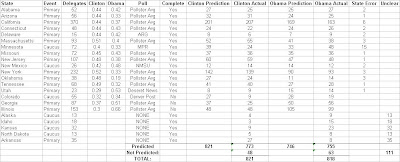
The chart below shows my Monday estimates for each state, compared to how each candidate actually fared. The "state error" column shows by how many delegates the estimates were off. I have not produced numbers in this column for CO, GA, and IL chart since we don't have full delegate estimates for those states.


Also, keep in mind that I did not make estimates in states where there was no polling, though I do include the actual totals in the table.

I'll update this post as I get updated numbers and see how the estimates fared in the remaining states. However, I think it is important to note that the polls (particularly the pollster.com averages) did a fairly good job of predicting final delegate allocations. So far they did seem to overstate Clinton's support slightly. The poll-based estimates predicted that she would win 52.4% of the delegates available in those 17 states; but so far, she has won only 50.6%. Nevertheless, the bottom line behind my estimates was that neither candidate was likely to come out of Super Tuesday with a significant lead in delegates, something that can clearly be affirmed by the outcome of the contests. Thus, the polling largely provided a useful way to predict eventual delegate allocations.

Mitt Romney Out

CNN is reporting, based on 3 different sources, that Romney is suspending his campaign. Not a big surprise, but notable nonetheless. How does this affect the Republican race? Do his supporters flock to Huckabee, or back the frontrunner?

UPDATE: Romney's exit raises the question of how well Huckabee would have to do in the remaining states to somehow keep McCain from picking up a majority of delegates. Based on an MSNBC account, the McCain campaign estimates that they have 775 delegates (of the 1,191 needed) with 963 yet to be determined. (They estimate that Romney has 284 and Huckabee 205). Based on those estimates, McCain needs to win 43% of what's left to have a majority of delegates going in. If conservatives did align behind Huckabee, it is certainly conceivable that he could keep McCain from getting what he needs, but how likely is it really? Will there now be pressure on Huckabee to suspend his campaign as well? It is essentially impossible for him to win it, but it is possible that he could deny McCain a pre-convention victory by staying in.

Still Waiting on the Final State-by-State Delegate Tallies

So far, I have not been able to find complete totals for AL, CA, CO, GA, IL, MO, NJ, NM, and TN. In some states, the totals are nearly complete. For example, MSNBC has 70 of MO's 72 delegates accounted for. But without those final tallies, I'm still waiting to find out how far off the poll-based estimates were. If anyone knows of a site with more complete information, please let me know.

We do now have complete tallies in 7 states. The poll-based estimates I produced were off by 1 delegate in AZ and UT, 2 delegates in CT and DE, 3 delegates in MA and OK, and a whopping 15 delegates in MN. However, in the states with polling data available, I predicted Clinton would take 52% of the delegates...right now, the tally is that she is taking 51%.

------

Hotline's blog has this interesting quote from the Obama camp: "We’re going to debate but it’s not going to be dictated by the Clinton campaign. We’ll have details on our schedule, including debates, soon." Or, to paraphrase, "We are the frontrunners now."

------

Pollster.com has details on the polling in the upcoming states. Of course, the details are few. The last poll from VA was taken in 2007. There are some more recent polls from MD but they are still several weeks old (they show Obama ahead there). I'm sure we'll get a few polls in the coming days...you have to think the Washington Post is sponsoring a Potomac Primary poll, right?

------

Finally, with the help of CCPS staffers Alicia Prevost and Caitlin Zook, I'm putting together something on superdelegates that I think might be pretty interesting. I'm hoping to have something on that for you by the end of the week. Stay tuned...

May caucuses in Florida and Michigan?

The New York Post reported today that DNC Chair Howard Dean is encouraging Michigan and Florida Democratic Party chairs to hold caucuses sanctioned by the DNC so that both states can legitimately elect delegates.

MI Dem Party Chair Mark Brewer was quoted in the Detroit News encouraging everyone to "remain open-minded. So if someone comes up with a creative way that meets everyone's interests, we can do that."

My idea is this: Michigan and Florida should hold new contests on Saturday, May 10 (A Mother's Day Caucus). They should both allow voting by mail, Internet, and in-person at thousands of caucus locations in each state. A May date is far enough off that they would be able to get the events organized and voters educated about the new processes. Voting early by mail and Internet are important because these methods give voters other options for participating that might be easier than getting to a caucus location on election day. Michigan successfully used Internet voting in 2004, and Democrats Abroad are using Internet voting now in their week-long caucuses that started on Feb. 5.

These caucuses should be set as quickly as possible, and planning for them started right away, while the nomination race remains 50-50, so that no candidate has undue influence on the process. This would be in the best interest of the DNC and the best interest of the eventual Democratic nominee, because it removes the perception that Michigan and Florida Democrats have been disfranchised... so in the end this is also the best solution for voters.

Wednesday, February 6, 2008

Accuracy of Super Tuesday Democratic Delegate Estimate (Some Initial Evidence)

On Monday, I used poll averages provided by pollster.com to generate predictions as to how the Democratic delegates would be divided on Super Tuesday. We are still waiting to find out about over 500 delegates, so I haven't been able to do a full check on my estimates. However, using delegate totals from CNN I am able to check how accurate I was in five states.


These tallies show that the estimates were pretty close in 4 of the 5 states, but way off in the fifth. I was off by 1 delegate for UT, 2 delegates for CT and DE, and 3 delegates in OK. However, the predictions were off by 15 delegates in MN. I'm not too surprised the MN estimate was off. First, it was a caucus state, and polling in caucus states tends to be far more difficult. Second, rather than an average from several polls, I had to rely on a single poll that was conducted January 18th-27th. The timing of the poll was particularly problematic, as it came too early to pick up any late shifts toward Obama.

Keep in mind that I did not make any predictions for AK, ID, KS, ND, and AR because there was no polling in any of those states. Obama ended up winning the delegates from those 5 states by a margin of 61-44.

I predicted that Clinton would win 52.4% of the delegates available from the states where polling data did exist...she is presently winning 51.1% from those states (again, with over 500 still to be determined).

I'll post another accuracy check once we have more information about the 500 or so outstanding delegates.

What Could Have Been...

If Michigan Democrats had stayed with their originally planned, February 9 caucus, it would be the most important contest happening this weekend. Barck Obama and Hillary Clinton would be in Michigan now, meeting voters holding rallies buying airtime. For the second presidential election in a row, Michigan Dems would have had the option of casting their ballots over the Internet - giving researchers valuable data on the effects of Internet voting on turnout (which I had planned to use for my dissertation).

Instead, Michigan Democrats foolishly (in retrospect for sure, but many thought it was foolish at the time too) and flagrantly violated the established calendar of the DNC and moved their contest to January 15. For Democrats, that primary was meaningless in almost every way: Barack Obama and John Edwards were not even on the ballot, no delegates were awarded, no candidates campaigned there. Instead it could have been a great battleground state for Clinton and Obama this weekend!

As Brian Schaffner has mentioned a few times on this blog, Michigan and Florida could (within the rules of the DNC) still hold delegate selection contests that would be recognized by the DNC. I think this would be more likely to happen in Michigan than in Florida, since Florida's primary produced an outcome similar to an actual delegate selection event, given that all of the major candidates were on the ballot. In Michigan, only Clinton was on the ballot of the candidates who remained in the race after South Carolina. So the primary that occurred there allocated delegates only to Clinton and "uncommitted" - none to Obama since he was not on the ballot. For Michigan to hold a caucus that would produce real delegates to the convention, their plan would have to be approved by the members of the DNC Rules and Bylaws Committee. The Michigan Democratic Party probably has enough money, and it surely has the organizational capacity to pull it off. The question is whether the party would have the support of Michigan's Dem elected officials, like Gov. Granholm and Sen. Levin, and DNC member Debbie Dingell.

Super Tuesday...Final Thoughts

Ok, it is 2am and I'm done. But not before I leave with you with a few final thoughts.

First, NM is still neck-and-neck. Looks like Obama and Clinton will likely split those delegates relatively evenly.

Second, I've been pushing this story for a week now, but I want to push it one more time. There is nothing that I know of that would stop MI or FL from holding a delegate selection event later in the calendar that would count toward delegates. This would probably be a caucus, but how could either state party resist holding such an event as it now becomes clear that every delegate is going to be critical?

Third, is McCain essentially unstoppable now? Or will the conservatives rally behind Huckabee in an attempt to derail him? I happen to think that even if conservatives did rally, it would still be relatively impossible to stop McCain. But it will be very interesting to watch this play out in the next few days.

Fourth, who has the momentum on the Democratic side? Obama seems to do very well in caucuses, which suggests he will win some contests this weekend. The feeling around here is that he would also be advantaged in the Potomac Primary held on Chesapeake Tuesday (just to use both terms). What happens if he build some serious momentum from those contests? Can Clinton stop that momentum in OH and/or TX?

Fifth, will we have any big endorsements in the next few days?

Sixth, how far off will my pre-Super Tuesday predictions be? On Monday, I estimated Clinton would win 821 delegates today, Obama 746, and I did not predict 122 in states where we had no polling. Those 122 were in caucus states where Obama did very well, which probably helped him make up a lot of that gap. I'll post in the next day or so a check-up on how close I was, and then I'll start looking for polling for my Potomac Primary Prediction.

And with that wonderful alliteration, I'm off. I had a great time, and I can't wait to do it again in a week. Hope you'll join us.

Super Tuesday Live Blog (Midnight Hour)

1:56am

Chuck Todd is citing an 89 delegate advantage for Clinton among super delegates.

1:55am

Howard Fineman is now discussing the super delegate picture. The big question, do the super delegates start endorsing now or do they hold out as long as they can?

1:50am

So far there are over 100,000 votes for Edwards in CA...is early voting somewhat problematic for primary races where the choices are so fluid from week to week?

1:47am

Still some drama....NM has yet to be called for the Dems.

1:44am

I'm looking at the Missouri exit polls on the Democratic side and it is the first state I've seen where there is no gender gap. Obama and Clinton each split men and women evenly.

1:33am

Over the past 48 hours, this blog has had over 1,000 visitors from 49 states (I guess they don't have internet access in ND?) and 42 other countries. I'm relieved that at least a few people have been tuning in.

1:27am

Keith Olberman is evidently bored now as he was just suggesting that Clinton could call for a recount in MO. As I've already mentioned, it doesn't matter who wins if it is this close...so why bother?

1:25am

LA County was supposed to be a big bastion of Obama support. Only 9% of the precincts in there, but Clinton is up 58%-31% in those precincts.

1:13am

Obama absolutely cleaned up in caucus states tonight, winning over 60% of the vote in each one. The bad news for him, however, is that the only caucus states left appear to be Maine (this weekend), Hawaii, and Wyoming.

However, if FL and MI decided to get back into the game by holding a late party-sponsored delegate selection event, they would almost certainly hold caucuses. On the other hand, Clinton is strong in both of those states.

1:06am

Interesting nugget from the CA exit polls. 42% of Democratic voters said that they decided who to vote for more than a month ago. Of those, 64% went for Clinton. Just think how many votes Clinton had banked with the tremendous amount of early voting.

On the other hand, Obama won (though less decisively) those who had decided within the last month.

On oddity...of those who said they decided how to vote "just today", 6% went for Edwards. Not sure how to explain that.

12:54am

Howard Fineman follows up by noting that Obama is going to take a huge fundraising advantage over Clinton in February.

Obama seems to be ahead in the money, tied in the national polls, and tied in the committed delegates...does this mean we no longer have a frontrunner?

12:51am

Chuck Todd (MSNBC) has Obama up 659 to 623 in delegates before you factor in NM and CA.

After trying to guess how things go in CA, he estimates 841 for Obama to 837 to Clinton.

In other words, this night is going to end in a tie for the Dems.

12:39am

Interesting to watch the TV pundits struggling to figure out who won and who lost tonight. Delegate math really is unique in recent political history.

MSNBC is calling MO for Obama...as if it will make any difference in the delegate allocation if he wins by 5,000 or loses by 5,ooo votes.

12:34am

One other note. John Edwards is pulling 11% right now in CA. Early voters, I assume. That is not enough to be viable, but still pretty significant share of the vote.

12:32am

Just to give you a sense of how sensitive those estimates are to the Clinton lead in CA, if the state ended up 55%-40% for Clinton instead of 55%-32%, my estimate would have Clinton and Obama exactly tied in delegates for the night.

12:24am

Just used the current vote percentages in each state to come up with my own estimate of how the delegates might break down when all is said and done. Here is what I came up with:

Clinton 848 delegates, Obama 807 delegates, with 26 delegates undecided (no results from NM).

That result is very sensitive to the CA results, which were 55-32% for Clinton when I threw them in the spreadsheet.

I can't see any candidate coming out of this with more than a 50 delegate lead (not counting superdelegates).

12:16am

And NBC calling CA and MO for McCain.

I'm going to attempt a new delegate count estimate for Democrats in a minute based on current vote totals in the states. Be back with that in a minute...

12:12am

NBC calls CA for Clinton. Let the spin begin...

12:01am

Obama is still speaking...hey, it is still Super Tuesday in IL.

12:00am

So, there are about as many different delegate counts out there as there are websites. And they are all over the map. Stay tuned.

12:00am

Wow, how about Missouri...neck-and-neck for both parties primaries. Can McCain hold on? It really doesn't matter who wins at this point on the Democratic side, they'll both get about half the delegates.

Tuesday, February 5, 2008

Exit Polls

12:51 am
I think we've had our first reversed call of the night. The AP has reversed its prediction that Hillary will win MO, now saying it is too close to call.

11:15 pm
CBS News has exit polls up for all of the states where polls have closed. Here is California's

Just noted on CNN was the huge margin of Asian voters supporting Clinton (73%) over Obama (25%)

NBC has a nice summary of the exit poll results. Here's what they say about race and gender:
"In the Democratic races, Barack Obama led with eight in 10 black voters and Hillary Rodham Clinton led with just over half of whites. Obama’s support among four in 10 whites across 16 states was more than he had captured in earlier primary states. Clinton won six in 10 Hispanic voters. Obama led among white men, while Clinton led among white women.

Obama won in Alabama, Delaware, Georgia, and his home state of Illinois, all states where more than one-fifth of the voters were black. Clinton won in Arkansas, Massachusetts, Missouri, New York, and Oklahoma, states with fewer black voters, but she also won in Tennessee and New Jersey, both states where one-fourth of the voters were black.

Overall, Obama led among men and Clinton led among women, although her advantage among women appeared smaller than was seen in early primary states. An exception was New York, which Clinton represents in the Senate. There, Clinton was competitive among men and gained the support of four in 10 blacks. In Arizona, Obama was more competitive among Hispanics than he was nationally.

In the Republican races, John McCain led among men. He was tied with Mitt Romney among women."

Earlier today, our political science colleagues at the Election Updates blog warned that the California exit poll results could be meaningless because so many voters there cast absentee ballots. Given that early absentee votes might have been more likely to be for Clinton (conventional wisdom would say that since she was doing so well there in polls until recently, and that she has done well among older voters who are more likely to vote absentee) it seems like she might do better there even than the exit polls suggest.

Too Close to Call

12:54 am
Even with Hillary taking the biggest prize of the night - California - the race for the nomination is still pretty much 50-50, way too close to call. So now we look ahead to states that have not had a say in a presidential nomination in recent memory: Maryland, Virginia, the District of Columbia, Ohio, Texas...

Let's all take a step back from our delegate tallies and remember the conversation just a few months (weeks?) ago that focused on how frontloaded the nomination calendar was, how both parties would have a nominee after only a few small states had voted. How different the race has turned out! And how sad I am that my home state of Michigan had a chance to hold a meaningful Democratic primary (with Internet voting) on February 9. Instead, this race will likely end as it began: with Democratic party leaders arguing about rules and regulations. Then, it was about the injustice of small states going first versus other states jumping ahead of them. Now, it will be about the delegations from the sanctioned states that are also, or course, ironically, important battleground states. The DNC will have to do something to re-franchise the delegates in Michigan and Florida. At this point, it is pretty much anyone's guess what that something might be.


11:00 pm
Sorry I am joining late (2 toddlers to put to bed and too much excitement in our house with an election watch party!)

But in a way I feel like I haven't missed much, at least in big picture terms... we seem to be where most predicted we would be in the Dem contest, with Hillary and Obama winning pretty much what they were expected to win and NBC reporting that California is too close to call.

Of note perhaps, how well Hillary did in Mass? Did Sen. Kennedy's (and Gov. Patrick's) endorsement of Obama mean nothing? I am also surprised to see TN and MO called so early for Hillary.

As for the Republicans, I feel like we have turned back the clock to a week ago when this was a 3-man race. Also, it seems like their voter turnout has been low compared to Dem turnout.

Super Tuesday Live Blog, Headed Toward Midnight (11pm)

11:55pm

Clinton is performing significantly better than exit polls estimated in states like MA and NJ. In both states, initial exit polls showed an even split, yet she's winning MA 56-41 and NJ 54-44.

Obama appears to be off-setting that with his strong showing in caucus states though, so this really will be very close when all the delegates are counted up.

11:44pm

And just as I say that, here comes Obama, whose speech is beginning in the middle of McCain's. Again, how did his campaign let it come to this? Speaking 15 minutes before midnight. Were they trying to cut in on McCain on purpose? MSNBC and CNN both leave McCain for Obama.

11:37pm

Ok, so first (earlier tonight) the Obama camp was raising the expectations for how well they would do in the delegate count. Now they have still not sent their candidate, whose strength is his ability to deliver a good speech, out to speak tonight. Can anyone explain this decision to me? Is he waiting for the networks to call CA for Clinton? Is he waiting for everyone in states that vote in the next week to go to bed? Does this not seem like odd strategy to anyone else?

McCain is on now, so that will make Obama the last on TV tonight. I'd love to know why it happened that way.

11:35pm

Now that we are in the west, Romney is beginning to fare a bit better. He has won MN and MT.

11:29pm

So, which will the media go with..."Potomac Primary" or "Chesapeake Tuesday?" Russert is pushing the "Chesapeake Tuesday" label...perhaps I'll use that since Russert and I dine together quite often (ok, we dine at the same restraunts at the same time...2 Amy's in particular...not necessarily "together").

11:22pm

Chuck Todd (MSNBC) says that the delegates are presently breaking down Obama 594, Clinton 546.

He notes (as I did earlier) that Obama is cleaning up delegates in caucus states (CO was just called for him by FOX) and was able to keep Clinton's margins down in NY. Let's see how those CA margins turn out though. Remember that the CA vote translates into about 3.7 delegates per 1% of the vote.

11:20pm

No way Obama wins CA given that exit polls are showing him behind 51-44%. Supposedly we won't know the actual delegate allocation out of CA for a quite a while, given the complexity of figuring it out congressional district by congressional district.

11:18pm

According to NBC, Clinton wins AZ. The exit polls put her down by 2%, but she probably benefited from early voting there as well.

11:13pm

I just updated my delegate estimates based on the exit polls here and the estimates show Clinton and Obama essentially tied. However, there are 275 unallocated delegates because they were selected in caucus states where there was no exit polling. However, Obama seems to be winning those caucus states pretty big so far (2-1 margins in KS, ID, ND, for example).

Is Obama going to come out of this with more delegates than Clinton?

11:05pm

From the Hotline, Obama's people sees him ahead 606-534 in delegates.

11:02pm

Clinton speaking as local affiliates on east coast come on the air...did they carry any of this speech?

Polls closed in CA...not surprisingly, too close to call in that state.

Romney has won the ND caucuses "a place where he never lived, to our knowledge" according to Olberman.

Super Tuesday Live Blog, Caffeine Re-fill Hour (10pm)

10:58pm

Obama wins ID and MN's caucuses, and again, he seems to be winning them big.

10:55pm

So, I missed some calls. FOX gives TN to Huckabee and AZ to McCain. Doesn't Romney have to win CA to avoid being totally forgotten after the night Huckabee is having?

10:52pm

Sorry to be MIA again, had to answer some questions for a reporter. I think I'm going cross-eyed from staring at the computer screen so much.

Clinton comes out to get some time in right before the 11pm east coast news. Will Obama speak during those newscasts to try to get some live look-ins?

10:42pm

And just as I write that, NBC calls GA for Huckabee...this is shaping up to be a pretty good night for him (and it all started earlier today in WV).

10:36pm

Was just checking out the GA Secretary of State site. Huckabee has about a 3.5% lead. However, only 46 of 354 Fulton County precincts are reporting, and Fulton County is definitely not Huckabee country. In fact, Romney and McCain are both doing about twice as well as him there.

10:33pm

I honestly did not expect that we'd have more uncalled states on the Republican side at this point in the night. GA, AL, MO, OK, TN, and AZ still need to be called on the Republican side.

What if Huckabee takes GA, AL, OK, and TN? Isn't this just going to fuel the "conservatives don't want McCain" story?

Romney is speaking now, and he is definitely not conceding...

10:28pm

NBC just called CT for Obama.

Notably missing from the calls on the Republican side so far is AZ...should McCain be worried?

10:18pm

Obama is taking the KS caucuses with a huge margin (about 70-30). This is why I think he may end up ahead...he is dominating the caucus states so far.

10:15pm

Huckabee comes out and begins by attacking Romney. What is he going to do once Romney is out of the race? Doesn't he have to go after McCain at some point?

I've posted a slight update on my exit poll driven delegate estimates.

10:09pm

The Obama camp thinks they will be ahead in delegates when Super Tuesday is all said and done, and I'm starting to think they might be right.

10:03pm

NBC calls ND for Obama. That was a caucus state for which we never had polling, yet almost all the sites are reporting and Obama has a 63%-37% lead.

Utah also goes for Obama, which was expected based on the one poll I saw from that state before tonight.

10:01pm

Shocker...Romney wins Utah.

Super Tuesday Live Blog (9pm edition)

9:00pm

Hillary Clinton has won NY. How big will her margin be?

9:05pm

Big storylines so far? Obama and Clinton seem to be doing about as expected thus far. Huckabee is showing strong in states like AL (which has been called for him), OK, GA, and others. Does McCain want a two-person race between him and Huckabee?

9:15pm

I've posted another update on my delegate estimates, using exit polls available on media websites. Now only one leaked exit poll is factored in (CA). See the estimates here.

9:18pm

It looks like Clinton may win a lot of states by narrow margins which will lead to a virtual splitting of delegates in those states. If Obama is able to come out of this with a delegate lead because he was able to run up the score in IL, GA, and some other places, will the news media focus on delegates or states?

9:21pm

Let's catch up on where we are now. According to network calls:

McCain wins NY, NJ, CT, DE, IL.
Huckabee wins WV, AR, AL
Romney wins MA

Clinton wins NJ, NY, OK, TN, AR, MA, NY
Obama wins GA, IL, DE

What am I missing?

9:25pm

I was missing AL, which NBC just called for Obama. Clinton is winning the peripheral south (TN, AR, and OK) while Obama is winning the deep south (GA, AL, and SC last week). Obama's margins among blacks is incredible (almost 9 to 1).

9:28pm

If I had a polling firm and wanted to get some publicity, I would've done a Potomac Primary poll over the last two days and would release late tonight and early tomorrow morning. If there is a draw on the Democratic side, the reporters and commentators are going to be all too eager to jump on the next horserace story.

9:36pm

John King (CNN) shows us that Mitt Romney has only won a handful of counties in the deep south states. Isn't this why McCain should be more worried about facing off with Huckabee than with Romney?

9:38pm

Pat Buchanan makes the point I've been making about Obama running up the score in a handful of states...does that mean I should retire now? Joe Scarborough then asks "doesn't a tie (in delegates) go to Obama?" Sounds like the media is going to spin it that way if that is how it turns out.

9:43pm

Parker asks about the MI and FL delegations. Check out a post of mine on this point here. Bottom line, if they would make the difference on who wins or loses, there is no way the MI or FL delegates would be seated. However, MI and FL could still hold events later in the calendar if they wanted to.

9:48pm

So, during the hour after Georgia was called, the commentators went on and on about how Obama captured over 40% of the white vote in GA. Racial harmony was the theme of the hour. However, if you look at the AL exit polls, note that he did worse among whites there than he even did in SC (where his lack of support among whites was a major story). Interesting how the storyline can be so different just because the GA polls closed first.

9:54pm

The NYT reports that Clinton bought about 3 times as much advertising in MA as Obama.

CNN goes to the Clinton headquarters and then to the Obama headquarters. The crowds there are practically shouting across the country at each other "we've got spirit, yes we do, we've got spirit, how 'bout you?"

9:58pm

With regard to the Democratic primaries, earlier today I made the point that the media will probably spend too much time worrying about who will win or lose and not enough about the margins that lead to the eventual delegate count. What do you think? How are they faring so far on this front?

Just had an idea that a smarter person would have had earlier. For the post I start next, I'll post from the bottom up so that you don't have to scroll down every time you refresh. What can I say? I'm new to this live blogging thing!

Super Hour of Super Tuesday (8pm-9pm)

8:00:01pm

MSNBC calls IL for Obama and OK for Clinton.
MSNBC calls CT, IL and NJ for McCain and MA for Romney.

This is where the real fun begins. Isn't this so much more interesting than spending 5 hours on Ohio?

8:03pm

Looks like CNN made the same calls.

8:10pm

Since CT and NJ are winner take all, calling those states for McCain means that he has picked up 79 delegates. MA has a proportional allocation, so it remains unclear how many delegates Romney and McCain will each pick up there.

FOX has called AL for Huckabee.

8:13pm

MSNBC goes more into the exit polls...Clinton is winning Hispanics 61%-38%. What does that mean for the race, particularly in CA?

8:14pm

Keith Olberman is getting a little carried away now...getting way too excited about vote counts with less than 1% of precincts reporting. Calm down Keith, it is going to be a long night.

8:19pm

NYT is reporting that NBC is rescinding its call of OK for Clinton and that FOX has called TN for Clinton.

8:20pm

And NBC has now joined in on the TN call.

8:25pm

The broadcast news outlets and blogs appear to be abuzz with talk that the Obama camp is ramping up their expectations. One question: why do that?

8:29pm

Here comes Arkansas...immediate call for Clinton and Huckabee?

8:30pm

Answer: Yes.

8:34pm

There appears to be some discrepancy between the exit polls leaked earlier and the exit polls now being posted on the network websites as the polls close. I'll update the delegate estimate based on the exit poll numbers on the network sites as those go up.

8:47pm

I'm about to revise the delegate estimate based on the exit poll numbers. My revised numbers show Obama 727, Clinton 699, and 298 in states without exit polling.

8:52pm

The Clinton campaign is bragging about the red states that they've won...AR, TN, and OK.

8:55pm

Something interesting I found when going through the exit polls. About 6% in TN reported voting for John Edwards who, as you may have heard, left the race a week ago. Pretty strong support for a guy who is not in the race...why is that?

On MSNBC, Bill Richardson has taken advantage of his withdrawal of the race to grow a Gore-like beard.

8:58pm

NBC has called MA for Clinton. The exit polls showed Clinton and Obama virtually tied there.

9pm poll closings coming up. Any chance they'll be able to call NY for Clinton right away?

Democratic Delegate Estimates (Based on Exit Polls)

I've used the exit polls available online to create a new (and very rough) estimate of how the Democratic Delegates may be allocated after today. In addition to all the cautions I mentioned here about why these estimates are error-prone, add to that the fact that exit polls have had notorious issues in correctly predicting the vote in recent elections. Nevertheless, here are the estimates based on the leaked exit polls.

Remember that there is no entrance polling in caucus states and I also found no information for Utah. However, if this is at all accurate, Obama would get 724 delegates, Clinton would receive 725, and 275 are in states with no exit poll information. The big thing to note here is that if these polls are correct, Obama would have run up the score significantly in IL while Clinton would have won her own state by a much smaller margin. Obama would also have benefited from running up the score in states like AL and GA.

Stay tuned...

UPDATE: I've updated the sheet to reflect the slightly different numbers that the media outlets have made available for the states where polls have closed. (NEP* indicates an exit poll from a media website, NEP indicates that I'm using numbers from leaked polls).

UPDATE 2: The sheet now reflects only one leaked exit poll (CA).


UPDATE 3: I've added UT's exit poll to the mix. Now just waiting for CA's.
UPDATE 4: Just added CA's exit polls from the media outlet websites. With regard to the unallocated 275 delegates, Obama seems to be doing well in those unpolled caucuses states so far.

Georgia and the run-up to 8pm (7pm-8pm)

S7:05pm:

All the networks call Georgia for Obama. Evidently the networks are calling Georgia a 3-way race for Republicans--should be very interesting to see how that shakes out.

Question about Obama's quest for delegates in Georgia: Since 57 delegates are allocated at the congressional district level, will Obama be helped or hurt by the fact that Georgia has a couple of majority-minority districts?

7:12pm:

MSNBC is reporting that Obama got over 40% of the white vote. That is an impressive figure.

Of course, the margin for Obama is more important than winning the state, but the fact that they could call it right away suggests he will have a significant margin.

If there is nothing to report on the Republican side, Obama will get an hour's worth of favorable news coverage before the 8:00pm polls close. Could this possibly affect how people vote on the West Coast?

7:22pm:

Leaked exit polls...read with caution.

7:46pm:

Sorry to be MIA for a while there. As you can see above, I was creating a new delegate estimate based on leaked exit polls. Hey, the exit poll figures were out there, was I supposed to just ignore them?

7:55pm:

There has been nothing to say on the Republican side, so the networks have been focusing a great deal on Obama's victory and particularly with how well he did among whites.

Polls closing at 8pm are AL, CT, DE, IL, MA, MO, NJ, OK, and TN. Based on those leaked exit polls, I'd expect the networks to call AL and IL for Obama and OK for Clinton pretty quickly.

How many states will be called for McCain?

Super Tuesday Live Blog: Early Thoughts (5:45pm-7:00pm)

5:45pm:

There will be no entrance polls in caucus states tonight (NYT). That means it will be awfully late when we find out what happens in states like North Dakota and Idaho. We've had essentially no polling in those states, so we really don't what will happen there.

CNN has started telling us a bit about the exit polls. Evidently only 49% of those voting for McCain labeled themselves conservative (the numbers were much higher for Huckabee and Romney).

Questions I'm wondering about:

What does "victory" look like tonight? Given how close this seems to be on the Democratic side, can Obama or Clinton claim that they won if they come out with more than a 100 delegate lead (not including pledged delegates)?

Related to the above, if we don't know who won or lost, when do the candidates come out to address supporters? Do they come out after they win their home states? Wait for someone to call Calilfornia?

How much time will the networks spend obsessing over who wins and loses states like Missouri when the margin of victory in IL and NY is at least as important? (See the earlier post on this point).

Would McCain be more worried if only Huckabee leaves the race or if only Romney leaves the race?

This is the closest thing we've ever had to a national primary...what will we think of it when it is over? Big success? Big failure?

6:00pm:

My home state of Georgia is the first to close its polls one hour from now. Here is the site where you'll be able to track those returns as they come in.

6:20pm:

Is this a hint that things will go well for Obama? MSNBC releases more from the exit polls. Here is a potentially crucial nugget: 53% chose change at the most imporant candidate quality, 22% selected experience, 14% selected cares about people like me, and 9% selected electability. The high numbers for change seem good for Obama, which MSNBC confirms as they indicate that three-fourths of those selecting the change quality voted for Obama.

But the exit polls can't get to the earlier voters...how much will those help Clinton?

6:30pm:

This is the first election for which Georgia has had its controversial photo identification requirement for voting. This may be causing long lines at the polls (story here).

6:40pm:

Another hint from the exit polls?

6:55pm:

Mark Blumenthal has a nice post discussing the large variance in the state polling leading up to Super Tuesday.

Five minutes till the polls close in Georgia. What will come first, the networks calling the state or my pizza out of the oven?

7:00pm:

My pizza beat MSNBC's call of Georgia for Obama by about 30 seconds.

Huckabee Big Winner So Far

Yep, he won 18 of West Virginia's 30 delegates (the other 12 will be determined by their primary held in May) at the convention today. This gives Huckabee a great deal of momentum and positive news coverage for at least the next 2 hours. This afternoon belongs to Mike Huckabee.

See you in a couple of hours...

Super Tuesday Democratic Delegate Cheat Sheet--How to Understand the Results

If either Obama or Clinton runs away with a state like Missouri or Alabama with a 10%-20% victory, the news media is likely to make a big deal of the size of the candidate's margin in that state. But keep in mind that we are in a delegate battle now, so a larger than expected victory is really only important inasmuch as it translates into delegates. Given that the Democrats are allocating delegates proportionally, it is possible to come up with an estimate of how many delegates a candidate is likely to receive for each additional percentage of the vote they win in an state. Of course, this is just an estimate as some states, like California, allocate some of their delegates by congressional district which means the statewide vote may not exactly match up with the shares of delegates won by each candidate.


To give you a sense of how much more important the vote is in the big states compared to the medium-sized states consider the following example. In California, each additional percentage of the vote won by the candidates is worth 3.7 more delegates. In comparison, every 1% of the vote in Missouri is worth .72 delegates. If either Obama or Clinton win California by 3% tonight, the victory will net them about 11 delegates more than the other candidate. Yet, since the polling has been neck-and-neck there, the 3% win probably wouldn't be a big deal to the news media. However, in Missouri, the candidates would need to win by about 15% of the vote to get the same 11 delegate advantage from that state. Despite the fact that a 3% win in CA is equivalent to a 15% win in MO, you can bet that the media would make a much bigger deal of the 15% victory.

The other reason why this is important is because the candidates' home states of NY and IL are the 2nd and 3rd largest voting today. The media may not focus much attention on those states because they are not expected to be close and likely will not be. Yet, it makes a much bigger difference whether the candidates carry their own states by 70% rather than 66% than it does whether they win Connecticut by 2% or lose Connecticut by 2%. In the latter case, winning Connecticut by 2% rather than losing it by 2% will only translate into about a 2 delegate difference. On the other hand, if Obama wins IL by 70% rather than 66%, that would mean 6 additional delegates. If Clinton wins NY by 70% rather than 66%, that would mean 9 or 10 additional delegates.

Keep all of this in mind while you watch the returns tonight. And don't forget, check in to the blog as you watch those returns come in...I'll be posting early and often.

Monday, February 4, 2008

Live Blogging Super Tuesday

I will be live blogging (perhaps with some assistance from my CCPS colleagues) tomorrow night with news, commentary, and other thoughts as the results come in all through the night. I'll be armed with my laptop, a lot of caffeine, and a quick trigger on my remote control.

Republican Super Tuesday Delegate Estimate

I've spent a few hours going through the delegate allocation rules for each state posted on National Journal's site. There are about as many variations in delegate selection rules as there are states voting on Tuesday (that is a slight exaggeration, of course) which makes it nearly impossible to come up with any reasonable way of figuring out how many delegates each candidate will win on Tuesday. But I'll take a shot at a prediction anyway...

Let's start with the states with the most simple allocation plans. AZ, CT, DE, MO, NJ, NY, and UT each give all of their delegates to the winner of the statewide vote. McCain seems to have a safe lead in AZ, CT, NJ and NY, which would give him 230 delegates (50 from AZ, 27 from CT, 52 from NJ, and 101 from NY). UT is safely in the Romney column, which will give him 36 delegates. That leaves two winner-take-all states. In DE (18 delegates), the only poll taken recently indicates a 41% to 35% lead for McCain over Romney. In MO, the polls seem to indicate that either McCain, Huckabee, or Romney could win the state's 58 delegates, but McCain has a small lead in the pollster.com average, so let's give those to him.

MA allocates its 40 delegates proportionally according to the statewide vote. Based on current polls, Romney would receive about 25 of those delegates and McCain would receive 15.

TN allocates its delegates proportionally statewide and by congressional district unless someone receives 2/3 of the vote. Right now, polls put McCain at about 32%, Huckabee at about 25%, and Romney at about 22%. The number for Romney is significant since the threshold for qualifying for delegates is 20%. If we assume all three qualify and get a share of the vote proportional to what the polls show, then McCain would receive 21 delegates, Huckabee 16, and Romney 15.

Ok, so that was the relatively simple part, now come the complicated states. First, we have no polling for AK, AR, MT, ND, and WV (which is a convention), so we don't know who will win those 123 delegates. Second, CO, MN, and IL all appear to have events that don't really lead to any pledged delegates being selected, so I won't make any guesses to how that will turn out. That leaves us with AL, CA, GA, and OK. Each of these states allocates part of their delegates to the winner of the statewide vote, and the rest according to who wins the vote in each congressional district. But this mix varies significantly from state to state. While AL, GA, and OK, all award about half of their delegates to the winner of the state, CA only awards 11 delegates to the state winner and the rest are allocated by district. Since we don't have congressional district level polling, the estimates we create for these states are going to be even more subject to error. But I'll give it a try:

AL gives 24 delegates to the winner of the state and the remaining 21 go to winners of each congressional district. The polling shows McCain and Huckabee essentially tied (37%-35%) with Romney farther back (19%). If McCain wins, that gives him 24 delegates. Then let's assume that McCain wins 4 of the congressional districts and Huckabee wins three. That gives McCain another 12 delegates and Huckabee 9. The total then would be: McCain 36, Huckabee 9, Romney 0.

The polling in GA (30 statewide, 39 among districts) shows a three way split: McCain 32%, Romney 29%, and Huckabee 27%. Let's assume McCain wins the state and 5 of the congressional districts, with Romney and Huckabee each winning 4 congressional districts. The total would then be: McCain 45 delegates, Romney and Huckabee with 12 each.

The polling in OK (23 statewide, 15 among districts) shows McCain with 40%, Huckabee with 28%, and Romney with 21%. Given the way OK's districts are divided, I'd say that McCain would win the state and 3 districts, while Huckabee might pick up 2 districts. The total would then be: McCain 32, Huckabee 6, Romney 0.

Finally comes CA (11 statewide, 159 among districts) where polling shows a tight two-way race between McCain and Romney. Let's assume that McCain wins the state and one more district than Romney. That would give McCain 92 delegates and Romney 67.

So, before I add this all up, keep in mind that this estimate is likely to be much farther off than the Democratic estimate I calculated, largely because of how many of these delegates are distributed by winner-take-all rules at the congressional district level. But here is the very rough estimate of how things might turn out on the Republican side:

McCain would win 547 delegates, Romney would win 155, and Huckabee would capture 43 delegates, with another 261 delegates being determined in states where there is no polling or where the process should keep us from having a clear idea of how the delegate count might turn out. Even without the 261 delegates that we aren't sure about, that would get McCain about halfway to what he needs. Would that be enough to force Romney and Huckabee from the race?

Super Tuesday Democratic Delegate Count Estimate (2/4 Update)

I've updated my estimates of how the Democratic delegates will be divided by Clinton and Obama on Super Tuesday. Please refer to my original post for the many reasons why this is a VERY rough estimate. In the last version, I used the most recent poll I could find in each state. Since several polling firms have released very recent polls in many states (like CA, MO, and GA), I'm using Pollster.com's current average for 11 states, rather than choose one polling firm over the other (keep in mind, however, that if there is a strong surge toward one candidate or the other in the closing days, it may not show up in the average as clearly). In a handful of states where there has been little polling, I just use the most recent survey. As with the last estimates I produced, if there has been no polling in a state over the past few weeks, I simply put the delegates from that state in the "unclear" column.

One other thing to keep in mind, polling error in large states like CA, IL, or NY would affect the delegate total significantly more than polling error in AL or OK, simply because of the number of delegates at stake in the larger states. For example, the pollster.com average for CA shows a 44-37 Clinton lead, but some polls taken in the last few days have shown the race even. Depending on which estimate is correct, it could mean a significant difference in delegates.

Based on the estimates from the polls, Clinton would win 821 delegates on Super Tuesday, Obama would win 746, and 122 additional delegates would be decided in states where no polling is available. Thus, if the survey results are correct, Clinton would come out of Super Tuesday with about a 50 delegate lead (not including super delegates).

I will try to post an estimate/prediction for Republicans later this evening.


CORRECTION: I mistakenly swapped Obama and Clinton's numbers in IL in my first posting and have now corrected the error (thanks to Dan for spotting the mistake).

Sunday, February 3, 2008

Democratic Super Tuesday Delegate Count Estimate

Ok, so this is really a fool's errand. First, we don't have any polls for a handful of states. Second, in the states where we do have polls, they are often relatively inconsistent. For example, of a handful of polls taken in NJ over the past few days, pollsters are reporting anything from a 43-42 (Zogby) Clinton lead to a 51-39 Clinton advantage (Survey USA). Third, and perhaps most importantly, my methodology really over-simplifies how delegates are allocated in each state. Nevertheless, I took some time during the slow first half of the Super Bowl (but, wow, what an ending!) to come up with a rough calculation of how Clinton and Obama would divide the delegates if the polling is correct.

I began with Rasmussen polls, mostly because they covered the most states (11). Then I tried to fill in other other polls where they were available and had been conducted within the last week. (The only exception is Colorado, where I used a poll taken 1/20-1/21). There were six states (and Democrats Abroad) where I could not locate any 2008 polling.

I used the percentage each candidate received in each state's poll to then allocate that state's delegates. I did this by calculating each candidate's share of the two-candidate vote. So, in the latest Alabama survey, 46% supported Clinton, 41% supported Obama, and 13% went to undecided or other candidates. However, that 13% will likely end up with Clinton and Obama on election day, so my transformation gives Clinton 53% of the two-candidate vote and Obama receives 47%. Based on these percentages, I simply allocate each state's delegates proportionally. Once again, this is not exactly how it is done in most states, but this is just one of many sources of error with my estimate and all the more reason to not take this estimate all that seriously. That said, my calculations produce the following estimate:

Based on these calculations, Clinton would win 784 delegates on Super Tuesday, Obama would win 757, and there are 148 delegates in states where we have no polling whatsoever. If you allocate the 148 evenly between the candidates, it would mean that Clinton would come out of Super Tuesday with a very small delegate lead.

NOTE: I will update these estimates with the most recent polling on Monday night.

NOTE 2: The estimates are a bit more difficult to create for Republicans since the rules differ so much from state to state. However, if I can, I'll try to produce a Republican estimate as well this evening.

NOTE 3: In the original post, I mistakenly transposed Clinton and Obama's numbers in Illinois, but have fixed it here and in the updated post here.

48 Hours: Last Minute Blitz from Obama and Clinton

The Obama campaign is apparently airing an ad in 24 states during tonight's Super Bowl. You can see that ad here.


There is also an interesting video that first popped up yesterday and is now furiously circulating the web. It puts Obama's New Hampshire concession speech to song and features several celebrities. If you are interested, check it out here:


In the meantime, Clinton is holding a virtual town hall meeting on Monday evening, an hour of which will be aired on the Hallmark channel.

The New York Times is reporting that the candidates have spent at least $19 million combined on these ad blitzes. How much will this work for either candidate?

Could there by any surprises in store for the last 48 hours before the polls close?

Will the Super Bowl keep our minds off of politics for a few hours?

Dems in a Dead Heat: Gallup Tracking Poll

Gallup has released its latest national daily tracking poll. As always, the results include interviews conducted over the previous three days. Yesterday, I posted about a bump in Clinton's numbers, but that has largely disappeared today with Obama up 3% and Clinton down 2%, which means that the two candidates are in a statistical dead heat nationwide.

There are a ton of new state polls out and a lot of them lead to different conclusions. It looks like Clinton and Obama will each win their home states fairly easily. There are several that are clearly leaning one way or another (GA for Obama, OK for Clinton, for example), several that are neck-and-neck (such as CA, MO, CT), and then several states where we really have no polling to look at (ID, MT, and AK, for instance).
I'll try to post more on the state-by-state polls later, particularly if the Pats are winning in a blowout.

Saturday, February 2, 2008

Who Benefits from Edwards' Withdrawal? (Volume II)

The newest Gallup tracking poll is out. This is the first of their tracking polls including only interviews conducted after the Edwards announcement (interviews conducted Jan. 30-Feb. 1). I've added a line to show the last day that Edwards was in the race.

Before Edwards exited, his support stood at 12%, Clinton was at 42%, and Obama was at 36%. Since then, Obama has gained 5% and Clinton has gained 6%. Given that the margin of error for the survey was 3%, we can't be confident that either candidate did better since Edwards left. The other problem is that the movement in the candidates' numbers could be chalked up to anything else that has happened since Edwards left, such as Thursday's debate. In fact, given that Clinton picked up only 1% on Wednesday and Thursday but 4% on Friday, does this actually reflect that her bump can be attributed to her performance in the debate? If her numbers continue to go up over the next two days, then that may provide more evidence for the latter explanation.

I didn't have time to download the Republican figure, but McCain's lead is up to 20% over Romney (44%-24%, with Huckabee receiving 16%).

Friday, February 1, 2008

New Gallup Tracking Poll: Democratic Race Continues to Tighten and Some Evidence of the Effect of Edwards Withdrawal

Today's national Gallup tracking polls are out and they show the race continuing to tighten on the Democratic side and continuing to favor McCain among Republicans. Clinton's lead is now down to 3% nationwide, which is the margin of error for the survey. The most recent survey included interviews conducted the day before, day of, and day after the Edwards' announcement. Before his announcement, Edwards support stood at 12%, it is now down to 4% and will likely be gone altogether by tomorrow's poll (which will only include interviews conducted after his withdrawal). Neither Clinton nor Obama seems to have gotten all of this support, with both seeing relatively similar upticks in their percentage of support since his withdrawal (the changes are so small that it is impossible to say with any statistical confidence that one candidate has done better than the other since Edwards withdrew).


McCain continues to hold a 15% lead over Romney in the tracking polls. McCain's support has also increased signifcantly more than Romney's since his victory in Florida and subsequent endorsement from Giuliani.


Pew Report: Evidence on the Effects of Cell Phone Use on Polling Accuracy

The Pew Research Center for the People and the Press has released an interesting new report addressing the effects of increasing cell phone use on the quality of telephone surveys. The concern has been that as more Americans rely more exclusively on cell phones (which are unreachable by traditional telephone survey methods), the representativeness of survey responses are declining significantly.

Pew used a survey of landlines compared with a survey they conducted of cell phone numbers. While they found some demographic differences between the two groups, particularly with regard to age, they noted that "When data from both samples are combined and weighted to match the U.S. population on key demographic measures, the results are virtually identical to those from the landline survey alone." Pollsters using traditional dialing methods have often argued that they can minimize the concerns about cell-phone-only households by weighting their samples accordingly. The Pew report provides support for this assertion:

"On key political measures such as presidential approval, Iraq policy, presidential primary voter preference, and party affiliation, respondents reached on cell phones hold attitudes that are very similar to those reached on landline telephones. Analysis of two separate nationwide studies shows that including interviews conducted by cell phone does not substantially change any key survey findings."

There is a lot of information in the Pew report, and it is a much read for those interested in survey research. Check out the full report here.